



Article Summary
- Automate 2026 conversations validated that manufacturers want practical, outcome‑driven MES and AI, not more pilots and demonstrations.
- Plant leaders are hungry for a single, trusted data backbone that spans planning, execution, and analysis, which is exactly where Rain Engineering’s Proficy expertise lives.
- Customers asked for AI tied directly to line performance and quality, aligning with Rain Engineering’s “practical AI in manufacturing” focus at Automate 2026.
- Visitors repeatedly described stalled or failed MES projects, reinforcing the value of Rain Engineering’s end‑to‑end, de‑risked implementation playbook.
- Across industries, attendees wanted partners who teach as they implement, mirroring Rain Engineering’s “Do Better” educational approach and resources.
If you only walked the aisles at Automate 2026, you might think the future of manufacturing is all about flashy robots and AI logos on booth walls.
But when plant managers, operations leaders, and continuous improvement teams stepped into the Rain Engineering booth, the conversation shifted quickly to something much more grounded: getting control of their data, stabilizing lines, and finally seeing MES deliver on years of promises.
In meeting after meeting, we heard the same frustrations and the same urgency, and those themes lined up with what we came to Chicago to spotlight: practical AI in manufacturing, rooted in a real Proficy‑driven execution layer instead of disconnected pilots.
In this article, we walk through the top five things we learned from customers at Automate 2026 and how Rain Engineering is already helping plants turn those lessons into higher throughput, better quality, and fewer surprises on the shop floor.
Customers Want a Real MES Backbone, Not Another Dashboard
One of the strongest messages from Automate 2026 was that manufacturers are tired of collecting data that does not change outcomes.
Many visitors came to our live Proficy line, built around the core question “Are you this good?,” and admitted that while they had “more dashboards than ever,” their OEE and changeover performance still felt stuck.
Several described plants where world‑class equipment still runs on spreadsheets, exactly the scenario Rain Engineering highlighted in its Automate campaign and in its broader 2026 MES playbook.
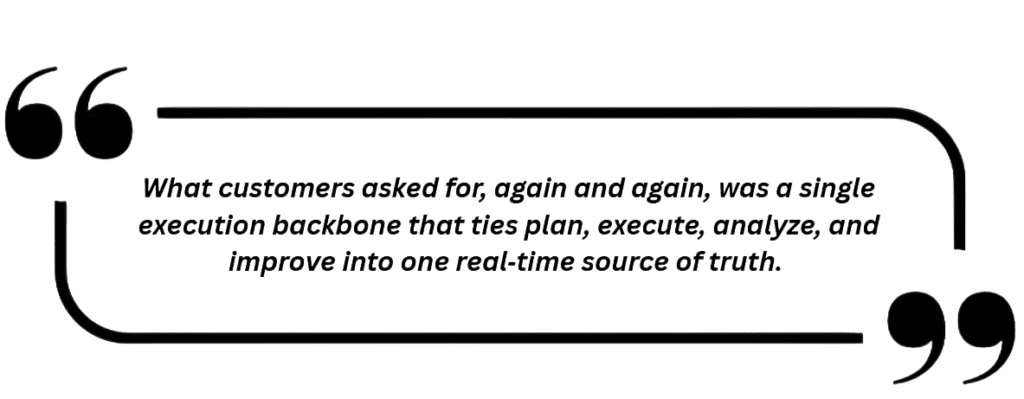
What customers asked for, again and again, was a single execution backbone that ties plan, execute, analyze, and improve into one real‑time source of truth.
That is precisely the role of a modern Manufacturing Execution System, and specifically what Rain Engineering designs and implements around Velotic’s Proficy platform.
Instead of a patchwork of line‑level tools and custom scripts, Proficy Plant Applications can standardize production models, track WIP, and contextualize downtime and quality events in a way that planners, supervisors, and engineers can all trust.
Rain Engineering’s work on complex, multi‑line environments has shown that when MES is implemented as the backbone, not an add‑on, teams finally get the end‑to‑end visibility they have been chasing for years.
At Automate 2026, those conversations often ended with a simple realization: without a robust MES spine, AI and analytics are just paint on the surface.
Because Rain Engineering has built its practice around de‑risked Proficy deployments, we can step into that gap with reference architectures, proven data models, and battle‑tested cutover strategies that help manufacturers move from “interesting demo” to “stable, repeatable execution” much faster.
AI Has to Live in the Line, Not Just in PowerPoint

Automate 2026, like many events this year, was saturated with AI messaging.
Yet when operations leaders sat down with us, their questions were remarkably pragmatic: … How will AI help my filler stay up?
… How will it reduce scrap on my bottling line?
… How does it plug into the MES and QMS systems we already own?
Those questions lined up perfectly with what Rain Engineering came to Chicago to emphasize: practical AI in manufacturing that is firmly grounded in production data and existing control architectures.
Instead of positioning AI as a standalone product, Rain Engineering treats it as an extension of the MES and historian layers you already have.
Proficy Historian and Proficy Plant Applications can provide high‑fidelity time‑series and contextual data, which then feed targeted AI models focused on specific use cases like predictive quality, anomaly detection, and changeover optimization.
This view aligns with broader industry movement toward AI applied to concrete plant‑floor problems rather than generic “factory of the future” visions.
At Automate, customers responded strongly when we showed how connected systems could surface actionable insights, such as highlighting specific combinations of product, crew, and equipment conditions that drive unplanned downtime.
That is where Rain Engineering’s positioning as a hands‑on MES expert matters.
Because our team has lived inside Proficy environments across industries, we know how to instrument lines correctly, structure models, and prepare data so that AI outputs are credible to maintenance and operations teams, not just data scientists.
The message from Automate was clear: customers are ready for AI, but only if it shows up as fewer chronic issues, faster root‑cause analysis, and improved first‑pass yield on the lines they run every day.
MES Projects Fail When They Ignore the People Who Run the Plant

Another recurring theme at Automate 2026 was frustration with MES initiatives that started with promise and then lost momentum.
Several visitors described projects that stalled after the pilot cell, left operators confused, or never achieved the standardized workflows corporate leadership expected.
These stories echo the challenges Rain Engineering was created to address: complex MES implementations, lack of internal expertise, and the gap between vendor promises and plant‑floor reality.
What we heard in Chicago matched what we see daily: technical architecture is only half of the equation.
The other half is change management, operator buy‑in, and building systems that reflect how production, maintenance, and quality teams actually work.
Rain Engineering’s approach, as described in its Automate profile and broader company messaging, explicitly emphasizes end‑to‑end solutions and unique educational resources to help plants “Do Better” throughout their digital transformation journey.
That means we do not just configure Proficy; we work with cross‑functional teams to define standard operating procedures, train line leads, and set up feedback loops so the system evolves with the plant.
Those Automate conversations validated that this approach is not optional anymore.
Manufacturers want a partner that shows up as an extension of their own team, bridging IT and OT, facilitating workshops, and translating MES terminology into the language of throughput, schedule adherence, and scrap dollars.
Rain Engineering’s leadership content, including its MES playbook for 2026, already leans into that role by cutting through hype and focusing on the operational headaches that keep plant leaders up at night.
Automate confirmed that this is exactly the kind of leadership customers are hungry for.
Plants Need a Single Version of the Truth Across Systems

A fourth message at Automate 2026 was about fragmentation.
Visitors to the Rain Engineering booth often rattled off a familiar list: ERP at the corporate level, multiple SCADA instances, isolated historians, point solutions for quality, and separate maintenance systems.
The result is an environment where no one trusts a single number and where every cross‑plant comparison turns into an argument about data definitions instead of an opportunity to learn.
Rain Engineering has consistently highlighted this challenge in its public messaging, emphasizing how connected systems improve visibility and plant performance.
Proficy, implemented correctly, becomes the connective tissue that contextualizes line‑level data and feeds clean, consistent information up to planning and business systems.
At Automate, when we walked visitors through how one real‑time source of truth can align plan, execute, analyze, and improve, it resonated with leaders who are tired of reconciling multiple spreadsheets after every shift.
The opportunity this creates for Rain Engineering is clear…
As a systems integrator focused on MES and data infrastructure, we can help plants rationalize their existing landscape, define canonical data models, and use Proficy as the foundation for everything from OEE reporting to advanced analytics.
That moves our role from “project implementer” to “data strategy partner,” which is exactly where manufacturers at Automate told us they need help to achieve consistent, multi‑site performance gains.
Education And Partnership Are Now Non‑Negotiable

Finally, Automate 2026 made it clear that manufacturers are not just shopping for software or integration hours; they are looking for long‑term partners who help them build internal capability.
Many visitors had downloaded or heard about Rain Engineering’s educational resources, such as its MES implementation success checklist and its ongoing blog content, and they were explicit that this kind of teaching mindset is what set us apart from vendors focused solely on selling licenses or billable time.
That response validated a core piece of Rain Engineering’s identity.
The company’s Automate profile emphasizes comprehensive solutions and “unique educational resources” as part of an overall mission to help manufacturers Do Better, not just install more technology.
This shows up in the way Rain Engineering structures projects: workshops to define outcomes before scoping, hands‑on training during deployment, and ongoing support that teaches teams how to own and extend their Proficy environments.
It also shows up in thought leadership such as the 2026 MES playbook, which speaks candidly about the gap between smart factory hype and the day‑to‑day reality on the plant floor.
At Automate 2026, that teaching‑oriented approach moved Rain Engineering from “one of many MES vendors” to a trusted guide for manufacturers trying to navigate AI, automation, and digital transformation without losing sight of their core production responsibilities.
The message we heard is that plants want a partner who will help them build internal champions and frameworks so that every project, from OEE baselining to AI‑assisted quality, leaves the organization stronger than before.
Bringing The Automate 2026 Lessons Home

Walking out of Automate 2026, the Rain Engineering team did not just leave with a stack of business cards…
We left with a reinforced mandate from the people who own production results every day: build MES backbones that actually support the way plants run, apply AI in service of specific line‑level outcomes, de‑risk implementations through education and change management, unify data across systems, and show up as partners who teach as we deliver.
Those are not abstract conference themes; they are the practical requirements for manufacturers who need to hit aggressive targets in 2026 and beyond while facing labor constraints, volatile demand, and aging assets.
Rain Engineering’s focus on Proficy, connected systems, and practical AI in manufacturing puts us squarely in the leadership position customers were looking for in Chicago.
The Automate conversations did not change our direction so much as confirm it and raise the bar for how quickly and transparently we need to help customers realize value.
As we work with manufacturers across industries, from food and beverage to specialty chemicals and automotive, these five lessons from Automate 2026 will guide how we scope projects, design architectures, and measure success on the plant floor.
FAQ
Q: What made Rain Engineering’s presence at Automate 2026 different from other MES and AI vendors?
A: Rain Engineering focused on a live Proficy line and practical AI scenarios tied directly to plant performance, rather than generic demos, which resonated with operations leaders looking for tangible outcomes.
Q: How does Rain Engineering reduce the risk of MES implementation failure?
A: By combining Proficy expertise with structured education, change management, and real‑world implementation playbooks, Rain Engineering helps plants avoid stalled pilots and achieve sustainable adoption.
Q: Where does AI fit into Rain Engineering’s approach after Automate 2026?
A: AI is treated as an extension of MES and historian layers, using production data to improve quality, uptime, and decision‑making rather than as a standalone solution.
Q: How can manufacturers start applying these Automate 2026 lessons in their own plants?
A: A practical first step is to define desired plant outcomes, assess the current data backbone around Proficy and related systems, and then prioritize MES and AI use cases that directly support those goals.
P.S. If what you saw at Automate 2026 left you wondering how to turn MES and AI into real, plant‑floor results, Rain Engineering would be glad to walk your lines, map your data, and show you what a Proficy‑centered, practical roadmap could look like for your operations.
