



ARTICLE SUMMARY
- Rain Engineering’s new Customer Experience Center gives manufacturers a hands-on environment to explore practical Manufacturing Execution System, or MES, use cases tied to production outcomes.
- Rather than focusing on generic software demonstrations, the Center helps visitors connect operational challenges such as downtime, quality, traceability, and manual reporting to realistic improvement paths.
- The Customer Experience Center opens publicly on September 30, 2026, giving manufacturers a place to discuss their production goals with experienced guides and see connected operations in action.
- For manufacturers evaluating MES, expanding an existing digital infrastructure, or trying to gain better visibility from plant-floor data, the Center is intended to turn technology conversations into clearer next steps.
Manufacturers have no shortage of technology options, software platforms, dashboards, and digital transformation promises.
What is often harder to find is a way to connect those tools to the real pressures production teams face every day.
A plant manager may need a faster way to understand why a line stopped.
A quality leader may need stronger lot genealogy and traceability.
An operations team may be spending too much time chasing paper records, reconciling spreadsheets, or waiting for information that should already be available.
These are not abstract technology problems… They are day-to-day production challenges that affect throughput, labor, quality, customer commitments, and profitability.
Yet many manufacturers are asked to evaluate complex systems through generic demonstrations that do not reflect their equipment, workflows, operators, or priorities.
Rain Engineering has created a different kind of experience.
Today we take a closer look at Rain Engineering’s Customer Experience Center and sit down with CEO Don Rahrig to discuss the many benefits he predicts the center will have for Rain Engineering and their customers.
Manufacturing Technology Must Start with the Operation
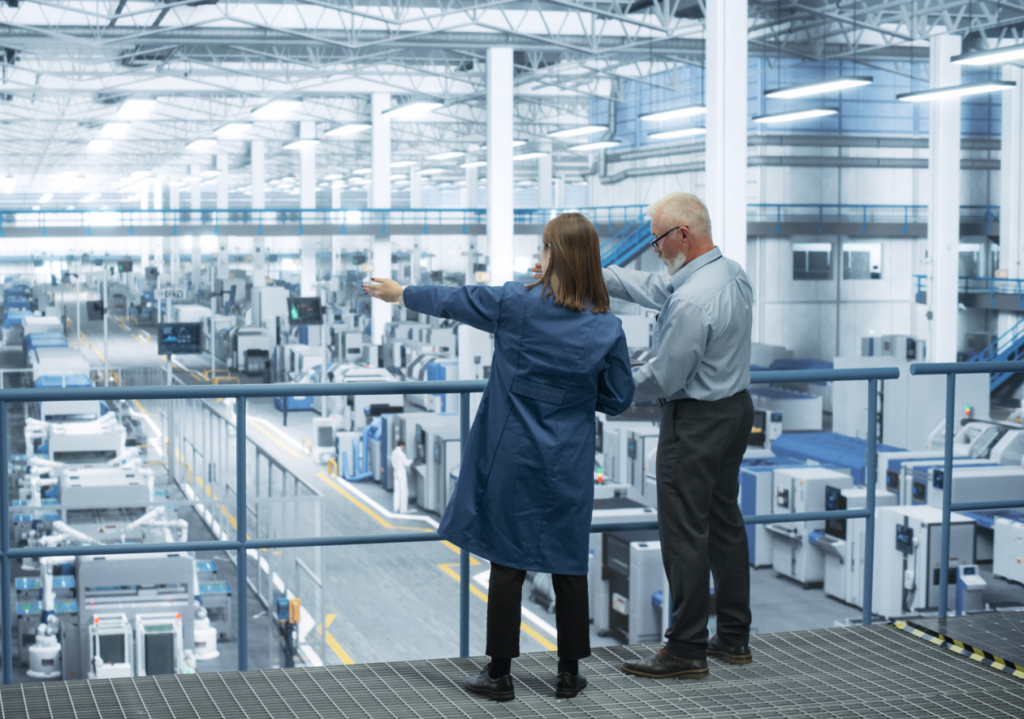
Manufacturing digital transformation can sometimes feel like a broad and intimidating term. It may bring to mind large-scale automation initiatives, enterprise software replacements, artificial intelligence projects, cloud migrations, or major capital investments.
Those initiatives may have value, but meaningful improvement often begins with a much more focused question: what is preventing the operation from performing at its best today?
For one manufacturer, the answer may be unplanned downtime.
For another manufacturer, the priority may be quality.
An MES can help bring these information streams together.
It sits between enterprise-level planning systems and the physical activity happening across the plant floor, helping manufacturers manage, record, analyze, and improve production execution.
But the value of MES does not come from installing technology for its own sake. It comes from applying the right capabilities to the right operational use cases.
That is the central idea behind Rain Engineering’s new Customer Experience Center (CEC).
On September 30, 2026, Rain Engineering will publicly open its Customer Experience Center, a space built to help manufacturers explore real production use cases, understand how Manufacturing Execution Systems (MES) can support operational improvement, and identify practical next steps for their facilities.
The goal is not simply to show software. It is to help visitors see how better-connected plant-floor operations can lead to better decisions and measurable results.
The CEC has been designed with manufacturers in mind, giving them a setting where they can lay out the details of their unique challenges, explore relevant use cases, and better understand what a practical solution could look like in a real operating environment.
A Different Approach to Software Demonstrations
Traditional software demonstrations can be useful, but they do not always answer the questions that matter most to a manufacturer.
The Customer Experience Center is intended to bridge that gap.
Speaking about the opening of the CEC and the impact he foresees it having on the manufacturing community, Rain Engineering CEO Don Rahrig had this to say: “We are excited to give manufacturers a place where they can move beyond the theory of digital transformation and see how connected production solutions can support the work happening on the plant floor every day.”
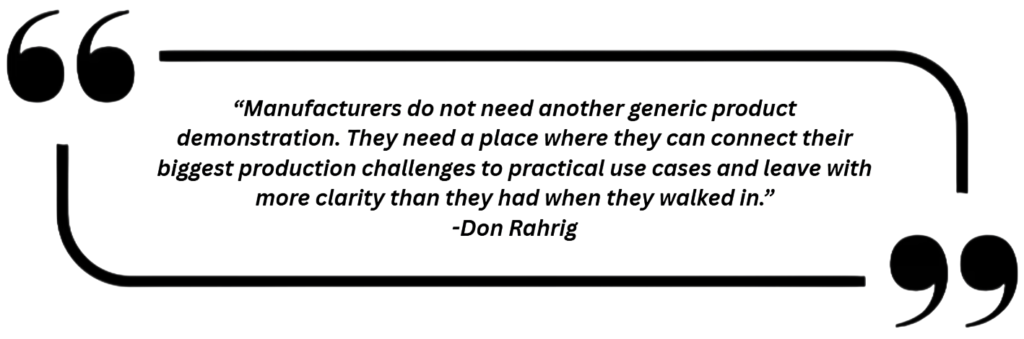
“Manufacturers do not need another generic product demonstration,” said Rahrig. “They need a place where they can connect their biggest production challenges to practical use cases and leave with more clarity than they had when they walked in. That is what the Customer Experience Center is designed to do.”
Rain Engineering’s approach is centered on scenarios that manufacturers recognize from their own operations.
Visitors can explore use cases related to reducing unplanned downtime, improving quality and traceability, replacing manual reporting with trusted production visibility, responding more quickly to issues, and strengthening the connection between equipment, personnel, and operational data.
“Our team is proud to open a space where manufacturing leaders can explore possibilities, ask detailed questions, and see how production data can become a more useful tool for action,” Rahrig said.
This matters because manufacturing improvement is rarely a one-size-fits-all effort.
Two plants may use similar equipment and produce similar products, yet have very different operational constraints.
One may have strong machine connectivity but fragmented quality processes while another may have reliable production data but lack a structured way to use that data for faster decision-making.
A practical MES strategy begins by identifying where the current process creates friction.
“The Customer Experience Center reflects the way Rain Engineering works with customers,” Rahrig said. “We start with the operational challenge, listen carefully to the people closest to the process, and help identify a practical path forward.”
The Customer Experience Center gives manufacturers an opportunity to talk through these challenges in a hands-on setting.
Instead of asking, “What can this software do?” visitors can ask more useful questions.
- What data do we already have?
- What information is missing?
- Which process should we improve first?
- What does success look like for our team?
- How can MES support the people who run the operation every day?
Those questions lead to more productive technology decisions because they focus on outcomes rather than features alone.
The Importance of a Practical Starting Point

One reason manufacturers delay digital initiatives is the belief that they must solve everything at once.
A facility may see opportunities in downtime, scheduling, quality, maintenance, traceability, reporting, and workforce enablement, then conclude that the project is too large to begin.
In reality, a successful transformation often starts with a focused use case.
A manufacturer might begin by digitizing downtime tracking on a critical production line. That effort can establish a more reliable view of lost time and recurring causes.
From there, the organization may expand into performance analysis, maintenance workflows, operator guidance, or production reporting.
Another manufacturer may begin with electronic batch records or lot traceability to address a specific quality or customer requirement.
Once that foundation is in place, the same connected environment can support broader visibility and continuous-improvement initiatives.
The right first step depends entirely on the operation.
It should reflect the unique business case, the readiness of the organization, the availability of data, the importance of the problem, and the ability of the team to sustain the change.
This is why a guided, outcome-focused experience can be so valuable.
Manufacturers do not need to leave a conversation with an unrealistic roadmap or a generic promise of transformation… They need clarity about the next right step.
“The best experience for a visitor is not leaving impressed by software. It is leaving confident about the next right step for their operation.”
“Every manufacturer’s journey looks different, but the need for clearer, more timely operational insight is shared across the industry,” Rahrig said. “We built the Customer Experience Center to help visitors identify the opportunities that matter most to their own operations.”
That statement captures the practical focus behind the Customer Experience Center.
The goal is not to create a temporary sense of excitement about technology. It is to help manufacturing leaders, operational teams, and technical stakeholders better understand where their facilities are today, where an improvement opportunity exists, and what action could create meaningful progress.
“When manufacturers can see their challenges reflected in a working environment, the path to improvement becomes much easier to understand,” Rahrig said.
That clarity is especially important for teams that have already invested in industrial software but want to get more value from it.
Many manufacturers are not starting from zero. They may already have enterprise resource planning software, programmable logic controllers, historians, supervisory control and data acquisition systems, machine interfaces, spreadsheets, or other production tools.
The opportunity may be to improve how those systems work together and how the information reaches the people who need it.
A Place to Explore What is Possible
The Rain Engineering Customer Experience Center is designed for manufacturers at different stages of their operational-improvement journey.
Some visitors may be evaluating MES for the first time. Others may be looking to modernize manual processes, improve production reporting, strengthen traceability, or connect equipment data more effectively.
In each case, the conversation should begin with the operation.
- What does the team need to see sooner?
- Which recurring issues consume the most time?
- Where are production records incomplete or difficult to access?
- Which manual processes introduce delay or inconsistency?
- What decisions are being made without enough timely information?
- Which improvement opportunities would have the greatest practical impact?
These are the questions that help manufacturers turn broad digital transformation goals into usable plans.
“We want visitors to leave with more than an impressive demonstration,” Rahrig said. “We want them to leave with a stronger understanding of what better visibility, traceability, quality, and performance could mean for their teams.”
Rain Engineering is a Velotic Proficy Platinum Solution Provider and systems integrator focused on MES, plant-floor connectivity, Proficy-based industrial software integration, and practical digital transformation guidance.
The company’s role is not only to help manufacturers select and implement technology, but also to help them clarify goals, define high-value use cases, and connect investments to operational results.
The Customer Experience Center brings that philosophy into a physical environment and gives visitors an opportunity to move beyond general discussion and see how connected systems can support the realities of production work.
The Wrap Up: Moving from Interest to Action

Technology should make manufacturing work easier to understand, easier to manage, and easier to improve.
It should help operators, supervisors, engineers, quality personnel, maintenance teams, and plant leaders work from more reliable information while supporting faster response when something goes wrong and better insight into what is working well.
Most importantly, it should serve the people and processes that make production possible.
Rain Engineering’s Customer Experience Center is being created to help manufacturers make that connection.
Beginning September 30, 2026, visitors will be able to explore real-world MES use cases, discuss their operational goals, and identify practical paths toward improved visibility, quality, uptime, traceability, and decision-making.
For manufacturers considering MES, expanding their plant-floor connectivity, or looking for a more practical way to approach digital transformation, the most important question is not whether technology can do more… It is what the operation needs most right now and how a connected solution can help achieve it.
The Customer Experience Center provides a place to begin answering that question.
(Read the official press release HERE.)
FAQ
Q: What is Rain Engineering’s Customer Experience Center?
A: It is a hands-on destination where manufacturers can explore practical MES and plant-floor connectivity use cases tied to real production challenges, including downtime, quality, traceability, reporting, and operational visibility.
Q: When does the Customer Experience Center open?
A: The Center opens publicly on September 30, 2026.
Q: Who should visit the Customer Experience Center?
A: It is designed for manufacturers evaluating an MES, seeking more value from current industrial technology, improving plant-floor connectivity, or pursuing clearer production visibility and operational improvement.
Q: How can a manufacturer schedule a visit?
A: Manufacturers can register through Rain Engineering’s Customer Experience Center registration page, available HERE.
P.S. Rain Engineering helps manufacturers turn MES, production data, and plant-floor connectivity into practical operational results.
The Customer Experience Center gives your team an opportunity to see these capabilities in a working environment, discuss the challenges that matter most to your facility, and leave with confidence about a practical next step.
Schedule a visit to explore how Rain Engineering can help connect your technology investments to stronger production performance.
