




ARTICLE SUMMARY
- An automotive MES case study is most valuable when it explains the operational problem first, then shows how plant teams converted production data into action.
- Automotive manufacturers use MES to create usable product genealogy, connecting material, tooling, machine, operator, inspection, and final-product records.
- Real-time downtime classification helps plants move from vague reports of lost production to targeted corrective action on the stops that matter most.
- When MES is incorporated during launch and commissioning, it can help standardize work, validate process readiness, and shorten the time needed to reach stable production.
- For automotive suppliers and manufacturers, the competitive advantage is not the software itself. It is the ability to make faster, more confident decisions with trustworthy shop-floor information.
Automotive manufacturing plants compete on more than unit cost… They compete on their ability to prove what happened to a part, contain a quality issue without disrupting unaffected production, recover quickly from a stop, and launch new programs without prolonged instability.
That requires reliable information at the same speed as the production line.
Manufacturing execution systems, commonly called MES, help connect the business plan to what is actually occurring at the machine, workstation, inspection gate, and shipping dock.
The following anonymized automotive MES case study stories show how that connection can turn traceability and throughput into a practical competitive advantage.
When Traceability Was More Than a Recordkeeping Task

One major two-wheeler manufacturer faced a familiar automotive problem: it needed end-to-end traceability for high-speed assembly, but the relevant information was spread across material handling, assembly operations, and inspection records.
A component could be present on the line, yet tracing its exact lot, consumption point, production order, and final vehicle association could require manual reconciliation after the fact.
The company addressed the issue by digitally capturing component and trolley information at the line.
Critical components were scanned, and the resulting records linked component lots to the relevant order and engine identification.
The plant also connected pre-delivery inspection records to the finished vehicle.
Rather than treating traceability as a separate quality activity, the operation made it part of normal production execution.
The published case study reported compliance with external traceability requirements and a 15 percent productivity improvement associated with reduced production planning and control work.
The lesson is not simply that scanning parts improves traceability… A barcode alone is only an identifier.
The operational value comes from associating the identifier with context: which order was being built, which station performed the work, which material lot was consumed, whether the part passed inspection, and where the finished product went next.
That connected record is product genealogy.
For an automotive manufacturer, genealogy matters most when something goes wrong.
If a supplier identifies a questionable lot, the plant needs to distinguish affected units from unaffected units quickly.
Broad containment actions can consume labor, disrupt service operations, and damage customer confidence.
A well-designed MES record can help quality teams search backward from a finished vehicle or forward from a material lot, narrowing an investigation to the products that actually share the relevant history.
This changes the conversation from “Can we find the paperwork?” to “What is the exact scope of the issue?”
That difference is a competitive advantage because it supports more disciplined recalls, warranty investigations, audit preparation, and root-cause analysis.
Turning Downtime into a Manageable Production Problem

Another recurring issue in automotive plants is that downtime data exists, but it is not dependable enough to guide improvement.
Operators may record stops manually after a shift, use broad categories such as “equipment issue,” or apply different labels to the same recurring failure.
The result is a plant that knows it lost output but cannot consistently identify the highest-value corrective action.
An automotive stamping facility built around a fully automated tandem press line used MES as part of its commissioning strategy.
The facility linked real-time machine signals with production tracking, material verification, tooling identification, inspection records, and downtime events.
The MES could log downtime based on programmable logic controller signals, capture the duration and reason for the interruption, and escalate prolonged events for attention.
That matters because a tandem press line is not one isolated asset.
It is a connected sequence of presses, robotic transfer equipment, conveyors, dies, sensors, and inspection points.
A misfeed, incorrect die, tooling problem, or transfer interruption can affect the flow of the entire line.
If production teams must reconstruct the event manually, the information arrives too late and often lacks sufficient detail for analysis.
In the published stamping case, the plant achieved capture or classification of more than 90 percent of identifiable stoppages through PLC integration.
The system also categorized downtime into operational causes, including die setting and other event types, so teams could analyze where available time was being lost.
This gave supervisors and maintenance personnel a shared operating picture instead of competing interpretations of a lost-production event.
The broader takeaway is that downtime reduction begins with definition quality.
If every stop is labeled differently, the plant cannot create a useful Pareto analysis.
If the machine signal, operator input, job context, and tooling state are linked in one event record, a recurring problem becomes visible.
Teams can then ask a more productive question: which cause is both frequent enough and long enough to justify a specific improvement effort?
Stabilizing a Launch Before Variability Becomes Normal
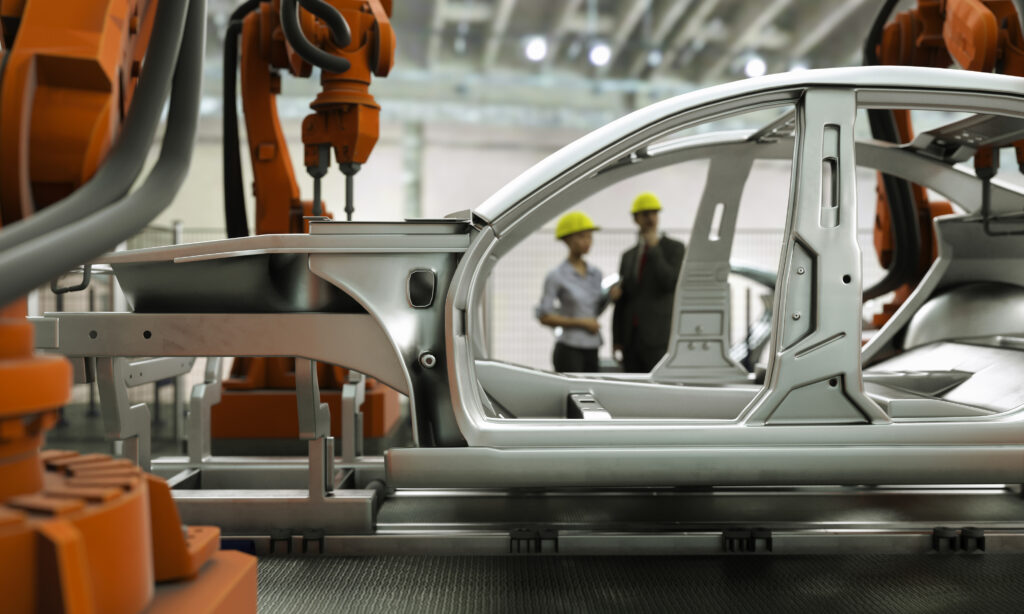
New automotive programs create pressure across production, quality, maintenance, logistics, and engineering.
During launch, a plant is expected to increase output while still proving that processes are repeatable.
Without timely data, early issues can become normalized: operators develop workarounds, quality checks remain paper-based, changeovers vary by shift, and the true causes of lost performance stay hidden.
The greenfield automotive stamping case provides a useful example of a different approach.
Instead of adding MES after production had already become established, the Tier-1 supplier incorporated MES considerations into facility design, equipment integration, standard operating procedures, and operator training.
The system was designed to connect enterprise resource planning data with press-line execution and to document material, machine, tooling, operator, quality, and downtime data from the first batches.
The plant’s launch process used digital controls at key decision points.
Material barcodes could be checked against the bill of materials before processing.
Radio-frequency identification could validate that the correct die was installed for the routing.
First-piece inspection had to be approved before full production could proceed.
During execution, production records captured press information, tool identification, inspection outcomes, scrap and rework status, and operator activity.
… This is an important distinction.
Launch stabilization is not merely a dashboard showing poor performance sooner. It is the use of structured production rules to prevent known errors from continuing downstream.
If an incorrect material or tool is detected before a run proceeds, the line avoids creating additional nonconforming product.
If first-piece approval is digitally tied to the job, the quality gate is less dependent on informal communication.
If changeover tasks are timestamped and consistently documented, the plant can separate a true equipment limitation from a procedural variation.
The results reported after seven months show why this approach matters.
Overall equipment effectiveness increased from 47.17 percent in the first month to 72.36 percent by month seven.
Changeover time fell by 37.50 percent, while the defect rate declined from 8.22 percent to 1.93 percent.
The study also reported complete digital traceability across material, machine, and operator layers from the first batch.
Those improvements should not be interpreted as a guarantee that every MES project will deliver the same percentages.
Every plant has different equipment reliability, product complexity, data quality, workforce readiness, and launch conditions.
The important point is the problem-to-outcome pathway: the facility defined performance measures early, captured standardized production events, trained personnel to use the data, and reviewed results during the ramp-up period.
The Competitive Edge Comes from Faster Containment

Automotive manufacturers and suppliers often describe traceability as a compliance need.
That is true, but it understates its business value.
In a fast-moving plant, accurate genealogy can support containment decisions before a problem spreads into broader inventory, shipping, warranty, or customer disruption.
Consider what happens when a defect appears at final inspection.
A disconnected process may force quality staff to search paper records, spreadsheets, production logs, and supplier documentation. In contrast, a connected MES environment can associate a finished part with the source material batch, process route, tool or die, machine conditions, operator record, inspection results, and rework history.
This gives investigators a clearer starting point for determining whether the issue is isolated, batch-related, tooling-related, or process-related.
The same data can improve throughput.
When a plant can see that rejects rise after a particular tooling change, or that a specific minor stop is accumulating across shifts, it can focus maintenance and engineering resources where they will have the greatest effect.
This is why traceability and operational performance should not be treated as separate initiatives. Both rely on capturing trustworthy production events at the point where they occur.
A practical automotive MES case study should therefore measure more than whether a system went live.
It should examine whether the plant can answer specific operational questions faster than before.
- Can the team identify every product associated with a suspect lot?
- Can it see why a line lost time during the current shift?
- Can it confirm that the correct tool, material, and work instruction were used?
- Can it compare changeover performance across shifts and programs?
These questions reveal whether the plant has moved beyond data collection toward operational control.
The Wrap Up: Building The Right Problem-To-Outcome Story

The most persuasive automotive MES stories do not begin with platform features.
They begin with an operational constraint that mattered to the plant.
Perhaps a supplier had slow recall containment.
… Or maybe a stamping line had inconsistent changeovers.
Either way, the MES becomes relevant only when it helps people resolve that constraint.
For manufacturers evaluating their own opportunity, the first step is to identify one recurring decision that currently depends on incomplete, delayed, or conflicting production data.
A strong starting point might be tracking material genealogy for safety-critical components, standardizing downtime codes on a bottleneck process, or linking tooling validation to a high-risk changeover.
Once the plant proves that the data is useful in one area, it can expand the model into quality, maintenance, scheduling, and continuous improvement.
The automotive plants that gain the most from MES are not necessarily those with the most elaborate technology stacks.
… They are the ones that use connected production data to make daily work more consistent, investigate deviations more precisely, and improve the speed of recovery when normal operations are disrupted.
FAQ
- Q: What is an automotive MES case study?
A: An automotive MES case study documents how a manufacturer or supplier used manufacturing execution data to address a production problem such as incomplete traceability, unplanned downtime, inconsistent quality, or launch instability.
- Q: How does MES improve automotive traceability?
A: MES can link material lots, serial numbers, production orders, operator actions, tooling, equipment data, quality checks, rework, and final-product records into a connected genealogy history.
- Q: Can MES reduce downtime without replacing equipment?
A: Often, the initial benefit comes from making stoppages visible and consistently categorized, allowing maintenance and production teams to identify repeat causes and prioritize corrective actions.
- Q: Why should MES be included during a new-plant launch?
A: Integrating MES during design and commissioning can establish data capture, process validation, training, quality gates, and performance measurement before informal workarounds become embedded in normal operations.
P.S. Rain Engineering helps manufacturers turn complex production challenges into practical engineering solutions. Whether the need involves process improvement, equipment integration, automation support, or reliable operational data, Rain Engineering brings a problem-solving mindset that supports safer, more efficient, and more competitive manufacturing operations.
