




ARTICLE SUMMARY:
- Engineering responses to major ship disasters like Normandie and Costa Concordia highlight how far large‑scale problem‑solving has advanced over the last century.
- The shift from manual calculations and limited data to model‑driven, sensor‑rich salvage operations mirrors the evolution of modern engineering practice.
- Today’s manufacturers can apply the same principles—real‑time visibility, simulation, and predictive analysis—to de‑risk changeovers, improve uptime, and strengthen operational resilience.
- Rain Engineering helps plants operationalize this evolution by implementing MES and connected‑factory solutions that turn production environments into data‑driven, continuously improvable systems.
The great ships that venture into our world’s massive seas have always been national showcases for naval architecture, propulsion systems, and structural engineering.
Yet, in moments of crisis, they become raw test beds for the people who design, model, and physically move thousands of tons of damaged steel in hostile conditions.
When disasters occur, the spotlight shifts from aesthetics and amenities to stability calculations, load paths, ballast strategies, and the ingenuity of salvage engineers forced to invent new methods at full scale.
Today, we take a look at 2 real life examples of such engineering feats, the SS Normandie and the Costa Concordia. Ships similar in their downfall, yet separated by decades, and what their engineered “resurrections” reveal about where advanced manufacturing and AI‑driven problem‑solving are headed next.
Two Wrecks, Two Eras

The SS Normandie entered New York as one of the most advanced liners ever built, a 1,029‑foot Art Deco flagship with innovative hull form, turbo-electric propulsion, and lavish interiors that made her both an engineering and cultural symbol of 1930s ocean travel.


By early 1942, under hurried military conversion after being seized by the U.S. government in the heart of WWII, she was a static, partially stripped hull tied up at Pier 88 on the West Side Docks in Manhattan—more construction site than luxury ship.

On February 9, 1942, a minor welding accident ignited a pile of nearby flammable materials; with the ship’s own fire pumps offline and city fire hoses incompatible with the ship’s yet to be converted European hose couplings, the fire spread rapidly through the ships unfinished spaces.

Fireboats poured huge volumes of water onto the port side, counter-flooding on starboard was mishandled, and by early morning on February 10 the liner had finally rolled onto her port side and settled into the Hudson mud, killing one person and shocking wartime New York.
Jump to 2012…

The Costa Concordia went down in a hyper-documented, sensor-laden age.
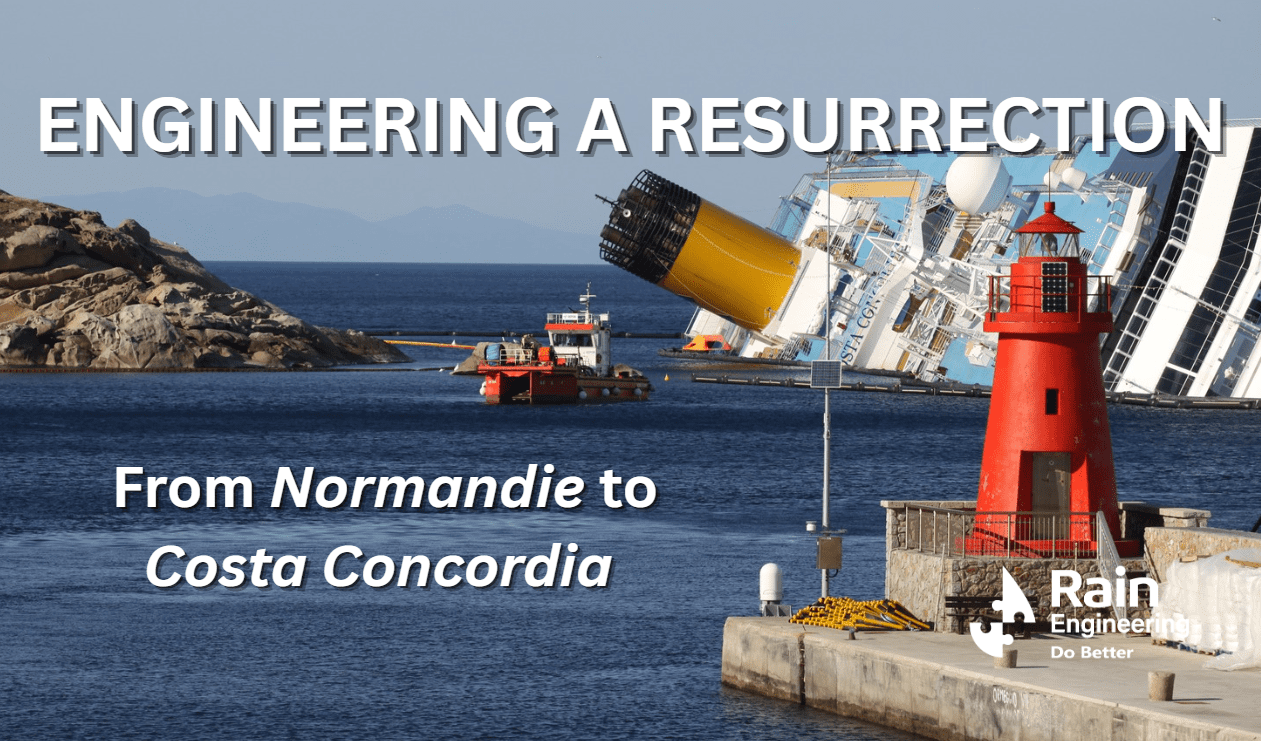
The 952‑foot, 114,000‑ton cruise ship struck a rock off Isola del Giglio during an unauthorized close‑in sail‑by in January 2012, tearing a 50‑meter gash in the port side and grounding on a sloping seabed just offshore.

Thirty‑two people died as the ship slowly heeled over and came to rest half-submerged on two rocky spurs, a wreck that – much like the Normandie before her — quickly became a media spectacle.
Salvaging Normandie: Heavy Steel and Hard Lessons

Once Normandie lay on her side, the U.S. Navy and civilian engineers faced an unprecedented salvage task in a busy wartime harbor: a thousand-foot hull blocking a key pier, sitting partially on its side in river mud, with the country desperate for troopship tonnage.
Salvors effectively had to “unlearn” luxury-ship design and treat the ship as a pure structure: cut openings, strip weight, seal the hull, and plan a controlled refloating that would not destabilize the pier or river traffic.

The operation leaned heavily on classical naval architecture and practical rigging rather than digital modeling.
Engineers used divers and manual survey to understand how the hull was embedded, then installed internal and external supports, pumped out compartments, and used carefully staged dewatering to bring the ship upright and afloat by August 1943—about 18 months after the fire.
The end results were not what officials had hoped for…

The Normandie was ultimately declared too damaged for economical repair and scheduled to be scrapped.
Despite this massive setback, the ship’s salvage itself became a live training asset; allowing the Navy Salvage School established nearby to use the wreck as a full-scale classroom, and resulting in techniques proven on Normandie that would later aid in the refloating of scuttled ships in ports like Cherbourg and Le Havre.

Normandie’s story is as much about systems failure as engineering success.
The ship’s own fire protection was offline; coordination between shipbuilders, the Navy, and city fire services was poor; and vital design knowledge—such as the architect Vladimir Yourkevitch’s plea to flood the ship evenly to avoid capsize—was ignored in the chaos.
Yes, the salvage that followed represented 1940s best practice, but it also underscored how much risk comes from fragmented information, delayed decisions, and limited situational awareness.
Salvaging Costa Concordia: Software, Sensors, and Spectacle

Seven decades later, Costa Concordia became the opposite kind of case study: the most technically demanding wreck removal ever attempted on a vessel of its size, with a public price tag in the billions and a global audience watching time‑lapse feeds of each engineering move.
Unlike Normandie, the Concordia could not simply be cut apart where she lay; she was perched on two rocky ridges above deep water, sitting just off a populated tourist island and atop a sensitive marine environment.
Engineers from Titan Salvage and Italian contractor Micoperi designed a solution built around parbuckling, a controlled rotation of the hull back to vertical.
Before any roll could begin, crews spent more than a year stabilizing the wreck: anchoring it to the seabed, installing a system of subsea platforms capable of supporting 175,000 tons, and placing grout bags—equivalent to 30,000 tons of cement—to create an artificial seabed between the rock spurs and the hull.
The parbuckling itself was a hybrid of heavy mechanical systems and continuous digital feedback.

Fifty or so massive chains and strand jacks were attached to the hull and to shore‑side structures; 11 huge steel sponsons were welded to the port side, designed to be flooded during rotation and later paired with starboard sponsons for refloating.
A control room on a nearby barge housed salvage masters, ballast engineers, ROV pilots, strand‑jack specialists, and software and design engineers, all watching real‑time data on loads, angles, chain tensions, and seabed reaction as the wreck inched around its axis.
During the September 2013 operation, strand jacks applied up to 6,000 tons of pulling force to free the hull from the granite ridges; once Concordia passed about 24–25 degrees, gravity and flooded sponsons took over and the ship rotated under its own weight onto the prepared platforms.

The move took roughly a day instead of the projected 10–12 hours, with pauses baked in for system checks, but the ship reached an upright position without catastrophic failure of the hull or platforms—a remarkable outcome given the size and damage.
Later, additional sponsons were attached, pumped dry to create buoyancy, and the wreck was refloated and towed away to Genoa for scrapping.
Where Normandie’s salvage was primarily a local engineering challenge, Costa Concordia’s was a global project that integrated hydrodynamic modeling, finite element analysis of hull stresses, environmental risk modeling, and project logistics on an industrial scale.

Hundreds of engineers across multiple countries contributed design work for platforms, sponsons, control systems, and monitoring software before construction and field execution even began.
Engineered Evolution: From Human Intuition to AI‑Assisted Factories
Side by side, the two operations highlight a sweeping shift in how engineers attack extreme problems: from hands‑on, largely analog improvisation to data-driven, simulation‑heavy orchestration.
Key differences include:
- Design tools: Normandie’s salvors relied on classical stability calculations, hand drawings, and incremental field tests; Concordia’s project team could use advanced CAD, finite element models, and hydrodynamic simulations to stress‑test scenarios before touching the hull.
- Sensing and feedback: In 1942, divers, sounding lines, and visual inspection provided feedback; in 2013, arrays of sensors, inclinometers, pressure gauges, ROV video, and centralized data systems fed live information to a control team adjusting loads in near real time.
- Risk framing: Normandie’s salvage prioritized clearing a strategic berth and potentially returning hull steel to useful service, with environmental risk barely considered; Concordia’s plan was shaped as much by ecological protection and coastal tourism as by structural concerns, with fuel removal and seabed protection designed into the work from the start.
- Project governance: Normandie’s work grew out of Navy command structures and a relatively tight circle of naval architects and contractors; Concordia required multi‑jurisdictional regulatory alignment, corporate liability management, and communication strategies to manage public scrutiny.
Yet, despite decades of technological advancements, there was continuity too…
Both projects demanded a deep understanding of ship stability, structural behavior under asymmetric loads, and soil–structure interaction between hull and seabed or riverbed.
Both required creative applications of basic tools—pumps, chains, temporary supports—applied at massive scale.
And in both cases, the salvage campaigns fed directly back into engineering practice, seeding new standards and training material for future operations.
Looking from Normandie to Costa Concordia, the bigger story for today’s manufacturers is not just how ships are saved, but how complex problems are solved.
In 1942, salvors relied on judgement, experience, and hand calculations; by 2013, they were leaning on models, real‑time data, and multidisciplinary teams to choreograph every movement of a 114,000‑ton wreck.
The same pattern is playing out on today’s plant floor: operations that once depended on “tribal knowledge” are increasingly guided by connected systems, advanced analytics, and model‑driven planning.
For manufacturers, this evolution is not theoretical.
Plants that integrate MES, real‑time data collection, and predictive analytics are doing the industrial version of parbuckling: reducing risk by simulating change before they make it, watching load and performance in real time, and adjusting proactively instead of reacting after something breaks.
That shows up as higher OEE, fewer unplanned outages, safer operations, and faster, more confident launches of new products or process changes.
In the end, the lesson from both Normandie and Costa Concordia is simple: the more instrumented, modeled, and connected your world is, the less you have to rely on heroics when something goes wrong.
Manufacturers who treat their plants like digital twins—streaming data from machines, feeding it into advanced algorithms, and closing the loop on the shop floor—are building organizations that can respond to disruption with precision instead of panic.
As AI, edge computing, and autonomous systems mature, the factories that thrive will be the ones that embrace this shift early, so the next “impossible” challenge in their operation is just another engineered maneuver rather than a “capsized” moment.
P.S. At Rain Engineering, that same evolution—from manual, experience‑only decision‑making to data‑driven, model‑assisted operations—is exactly what modern MES and connected factory platforms aim to deliver on the plant floor.
The more your production environment starts to look like a well‑instrumented “digital twin,” the faster and safer you can respond when something tips toward failure instead of waiting for the engineering equivalent of a capsized ship.
When it comes to your business, don’t let life catch you by surprise. Work to prevent accidents rather than simply cleaning up after them.
Want to learn how this can be done on your factory floor?
Applying This to Your World:
- How does the shift from Normandie to Costa Concordia reflect changes in engineering practice?
It marks the move from manual calculations and field improvisation to model‑driven, sensor‑rich, software‑assisted engineering.
- What can manufacturers learn from large‑scale ship salvage projects?
Plan with simulation first, instrument everything for real‑time feedback, and phase complex changes so risk and load stay controlled.
- How do these salvage stories encourage manufacturers to use data better?
They show that you cannot safely manage complex systems blind, pushing manufacturers to instrument equipment and processes so decisions are driven by real‑time facts, not hunches.
- How can these stories shape a smarter digital transformation roadmap?
They highlight the value of simulating and phasing change—test digitally, then roll out in controlled steps instead of risky, all‑at‑once overhauls.
