


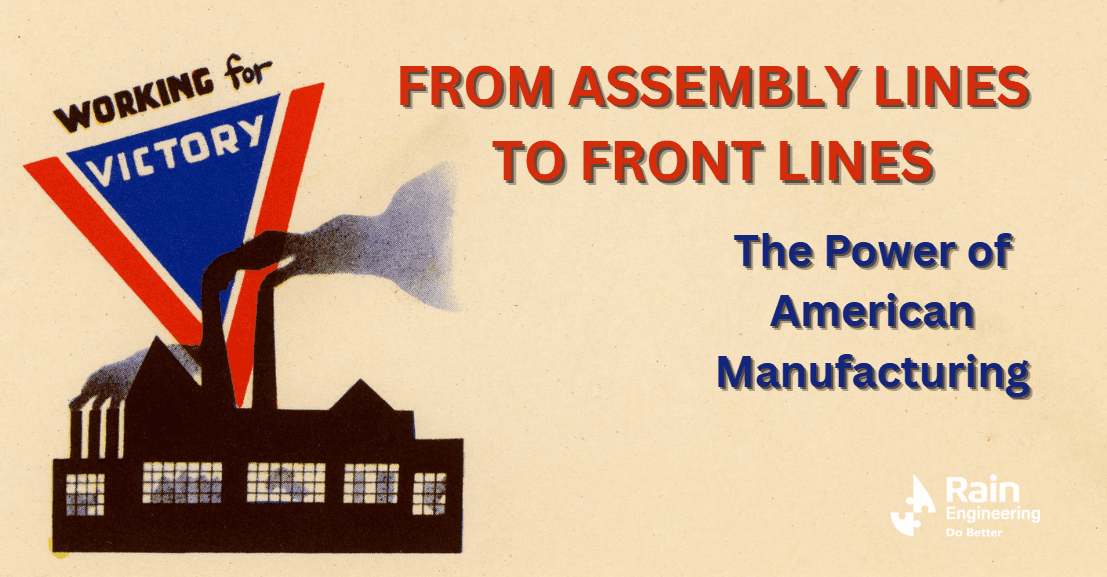


Manufacturing has quietly been one of the United States’ most powerful strategic assets, especially in times of war, turning raw industrial capacity into military strength, economic resilience, and ultimately, national survival.
From Liberty ships to MRAP vehicles, the story of American warfare is inseparable from the story of American manufacturing.
Today, we trace how those same factory floors, supply chains, and engineering cultures that once armed American soldiers still shape our national security and economic strength while providing a sense of shared purpose for us all.
Arsenal of Democracy

When President Franklin D. Roosevelt called the United States the “arsenal of democracy,” it was not a slogan; it was a strategy built on factories, foundries, and assembly lines.
In World War II, American industry converted from cars, refrigerators, and toys to tanks, bombers, ships, and munitions at a speed and scale the world had never seen.
Automakers retooled plants to build aircraft engines and armored vehicles, chemical companies pivoted to explosives, and small component makers shifted to cartridge clips and shell casings.
The numbers tell the story of why manufacturing mattered so much.
Between 1941 and 1945, the United States produced nearly 300,000 military aircraft, around 86,000 tanks, and millions of trucks and artillery rounds, supplying both its own forces and those of allies through programs like Lend-Lease.
This industrial surge did more than fill warehouses; it ensured that American and Allied troops rarely went into battle outgunned or undersupplied, turning production lines at home into decisive advantages abroad.
World War II shows most clearly how factory output shaped battlefield outcomes, but the pattern extends across multiple conflicts.
U.S. shipyards cut the time to build a Liberty ship from about four months to just a few days in some yards, enabling convoys to replace losses from German U-boat attacks and keep supply routes to Europe open.
A network of newly funded plants across the country created wartime jobs, trained a generation of skilled workers, and left communities with industrial capabilities that continued to pay dividends for decades.
In later wars, the same industrial backbone underwrote sustained operations.
During the Cold War and Vietnam, the United States maintained high output of aircraft, helicopters, munitions, and vehicles while simultaneously fulfilling NATO commitments, something only possible because of an already large and sophisticated manufacturing base.
More recently, during the wars in Iraq and Afghanistan, U.S. manufacturers ramped up production of Mine-Resistant Ambush-Protected (MRAP) vehicles, delivering over 16,000 of these lifesaving trucks in just a few years to respond to emerging threats like roadside bombs.
You see, wartime manufacturing did more than arm soldiers; it reshaped American society and local economies.
The mobilization of World War II drew millions into factories, including women and minorities who had long been excluded from industrial jobs, accelerating changes in labor markets and expectations about who could do “industrial work.”
Communities that received war plants saw long-term gains in employment, skills, and infrastructure, as facilities built for tanks or aircraft were later adapted for automobiles, appliances, and other peacetime goods.
This dual-purpose nature of manufacturing—able to pivot between civilian and defense production—has repeatedly cushioned the economic shocks of war.
After major conflicts, manufacturers have often led postwar growth by converting war capacity into consumer capacity, fueling housing booms, car ownership, and the spread of modern conveniences that defined mid‑20th‑century American life.
In this way, the same plants that supplied the front lines also underwrote the American middle class back home.
Deterrence and the Modern Industrial Base

Today, manufacturing remains central to U.S. security, even in an era defined by software, data, and precision weapons.
Advanced missiles, drones, stealth aircraft, and secure communications still depend on physical production: machine tools, composite materials, semiconductors, and specialized sub-tier suppliers that can scale under pressure.
The Department of Defense now talks explicitly about the “defense industrial base,” investing billions to keep critical production capacity alive, encourage innovation, and ensure the U.S. never has to fight on equal terms.
At the same time, recent conflicts and support to allies in Europe and the Indo-Pacific have exposed bottlenecks—limited surge capacity for munitions, fragile supply chains, and a heavy reliance on just‑in‑time practices.
These challenges have renewed focus on strengthening domestic manufacturing, building redundancy, and working with allied industrial partners, all rooted in the same lesson that defined earlier wars: in a prolonged conflict, the side that can out‑produce, repair, and replenish usually has the upper hand.
The Wrap Up: Your Role in America’s Industrial Story

All this history ultimately flows through individual people – our industrial warriors – who show up every day to make things—engineers troubleshooting a line, operators watching tolerances, planners scheduling runs, and leaders who refuse to cut corners when it comes to quality and safety.
The values that powered the arsenal of democracy—discipline, craftsmanship, pride in a job well done, and a commitment to continual improvement—are the same values that keep U.S. manufacturing competitive and resilient today.
When you care about throughput and traceability, when you obsess over uptime, when you fight for better tools and smarter processes, you are carrying forward a legacy that has shaped battlefields, communities, and the broader American economy.
That is why your passion for this industry matters so much.
In every kaizen event, every redesign to reduce scrap, every effort to cross-train teams or modernize equipment, you are reinforcing the capabilities that once helped win wars and now help secure America’s place in a very uncertain world.
Manufacturing is not just about units produced; it is about a culture of problem-solving and persistence that sets the United States apart—and that culture lives or dies with the people like you who choose to invest their talent, energy, and pride on the shop floor.
P.S. At Rain Engineering, the same principles that turned America into the arsenal of democracy—repeatable processes, real‑time visibility, and scalable production—are what modern manufacturers need to stay competitive in this volatile world.
From shop‑floor data integration to MES solutions that improve throughput and quality, Rain Engineering helps plants build the resilient, high‑performing operations that national strength and local jobs depend on every day.
Ready to take steps to future-proof your facility to continue your American legacy?
