





ARTICLE SUMMARY
- Manufacturers frequently encounter MES and AI implementation challenges rooted not in software capability, but in inconsistent, incomplete, disconnected, or poorly governed production data.
- A practical five-point review can reveal whether a facility has the data discipline needed to support dependable MES reporting, traceability, analytics, and AI use cases.
- Standard terminology, trusted event records, connected systems, clear ownership, and decision-making habits are foundational to successful digital-manufacturing initiatives.
- Rain Engineering helps manufacturers evaluate and improve the operational data practices that make MES and AI investments more useful, sustainable, and measurable.
At Rain Engineering, we understand manufacturers are at very different stages in their Manufacturing Execution System, or MES, journeys.
Some have long-established plant-floor systems and a mature understanding of production data. Others are evaluating their first MES deployment, considering industrial AI, or trying to understand why a system that is already installed is not producing the expected value.
Despite those differences, we find many facilities that struggle with new MES implementation, or an early AI initiative do not actually have a software problem. They have a data-readiness problem.
So, before you expand your MES, launch an AI pilot, or invest in advanced analytics, take this opportunity to examine whether your underlying data can actually support dependable conclusions.
The following five-point readiness checklist provides a practical starting point.
The 5-Point Data Readiness Checklist, at a Glance
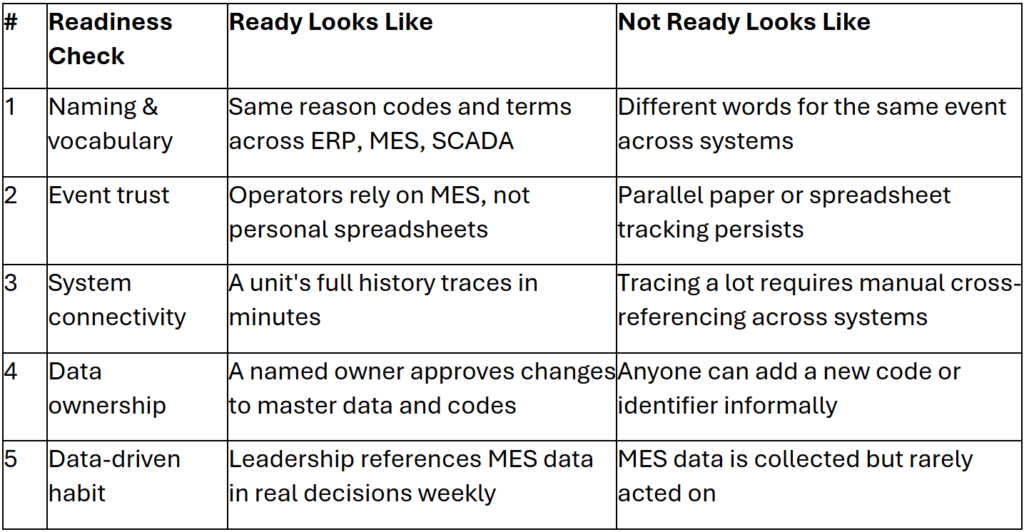
Do the Same Words Mean the Same Thing Everywhere?
In many plants, they do not. This is often the first and most important data-readiness gap to close.
If “downtime” is recorded one way on a production line, another way in the MES, and a third way in the ERP report reviewed by leadership, the organization does not have one reliable version of the truth. It has multiple interpretations of the same operating event.
This problem appears frequently in environments using platforms such as GE Digital Proficy.
For example, a changeover on Line 3 may be coded as a “planned stop” by one operator and a “changeover” by another.
Neither description is necessarily incorrect in isolation. However, if those events are not categorized consistently, the plant cannot accurately compare them.
A report intended to show changeover-time trends may quietly combine unlike events, omit relevant records, or create an inaccurate impression of performance.
Standardizing terminology, naming conventions, equipment states, and reason codes across ERP, MES, SCADA, quality, and maintenance systems is not glamorous work.
However, it is one of the highest-leverage improvements a manufacturer can make before introducing AI.
ISA-95 was developed specifically to support common terminology and structured information exchange between manufacturing control systems and enterprise systems, including the MES and ERP layers.
AI models also require this consistency. A model cannot reliably identify a pattern when identical plant events are labeled differently across shifts, lines, products, or systems.
Industrial AI depends on training data that is relevant, accurate, and connected to the task the system is expected to perform.
A useful test is to pull the ten most common downtime reason codes from the MES and compare them with the language supervisors and operators use to describe those same events.
If the terms do not align, the plant’s data vocabulary is not yet standardized.
Are Downtime and Quality Events Trustworthy?

A manufacturer should ask whether operators trust the MES records enough to stop maintaining their own spreadsheets, notebooks, or paper logs.
If informal parallel tracking still exists, it is often a sign that the system of record has lost credibility.
This does not necessarily mean that employees are resisting technology.
In many cases, they are compensating for missing fields, unclear reason codes, delayed data entry, unreliable machine signals, or reports that do not reflect what happened during the shift.
Their spreadsheets may be an attempt to preserve the production context they believe the formal system has failed to capture.
Downtime and quality records are especially vulnerable to this issue.
A record that simply states that a quality hold occurred provides limited operational value if it does not identify the cause, affected product, work order, machine, material lot, shift, operator, or process condition.
The event technically exists in the database, but it may not be useful for root-cause analysis, continuous improvement, customer traceability, or machine-learning applications.
The risk becomes greater when AI or predictive analytics are introduced.
A model intended to predict scrap risk, for example, needs contextual information about what occurred before a defect or quality hold. It must be able to connect the event to the equipment, raw materials, operating conditions, process settings, inspection results, and production order involved.
Incomplete records can do more than weaken reporting. They can cause a model to identify misleading correlations.
NIST’s guidance on industrial AI emphasizes that the data used by an AI system should be accurate and relevant to the intended task.
Poorly contextualized or inconsistent event data undermines that requirement before an algorithm ever begins training.
A practical trust test is to ask several operators independently what portion of their shifts they still document outside the MES.
If the answer is anything above zero, the plant should investigate why parallel records remain necessary.
The problem may be usability, workflow design, data latency, unclear definitions, missing integration, or a reporting process that does not return useful information to the people entering the data.
Do the Systems Actually Talk to Each Other?
If the ERP, MES, historian, quality system, and maintenance records require manual exports, rekeying, or spreadsheet reconciliation, the systems are not integrated. They are merely coexisting.
That distinction matters. Coexisting systems may appear connected in a presentation, but the gaps become obvious when someone attempts to trace a single finished unit from incoming material through production, inspection, packaging, and shipment.
This is where genealogy and traceability often break down.
If a customer reports a potentially suspect lot, the manufacturer may need to identify the machine involved, the shift, the material batch, related quality checks, process events, and every potentially affected finished good.
That trace should be completed in minutes, not days.
Effective traceability depends on common and persistent identifiers.
Equipment IDs, production-order numbers, material-lot numbers, product codes, timestamps, and quality records must remain consistent across all systems that touch the product. ISA-95 addresses the integration of business and manufacturing-control functions and establishes models for the information exchanged among them.
In practical MES environments, this means the ERP may provide orders and master data, the MES may manage execution, production tracking, and genealogy, and SCADA or historian systems may provide machine and process data.
The value emerges when these records can be connected without manual interpretation.
The relationship between the systems must be intentionally designed, maintained, and governed.
Manufacturers considering AI-assisted quality, predictive maintenance, production scheduling, or yield optimization need this connective tissue in place first.
AI cannot reliably reconstruct relationships that were never captured.
If the data does not associate a material lot with the machine, process conditions, work order, and quality outcome, an AI tool cannot confidently determine how those factors influenced one another.
A direct test is to select one finished unit from the prior week and time how long it takes to trace its complete production history across systems.
A trace that takes minutes indicates a strong foundation.
A trace requiring hours, days, or multiple manual spreadsheets indicates that integration and identifier consistency should be addressed before expanding MES or AI capabilities.
Does Someone Actually Own the Data?

If a facility cannot identify the person accountable for equipment hierarchies, material master data, downtime-code definitions, product attributes, or integration mappings, then no one truly owns the data.
This is not simply an IT issue… Data quality declines quietly when ownership is assumed rather than assigned.
New equipment may be added with a naming convention that does not match existing assets.
A new product may reuse a legacy material code.
A downtime reason code may be created for a short-term need but never aligned with the plant’s broader reporting structure.
Over time, these small inconsistencies create significant reporting, traceability, and analytics problems.
A system can contain thousands of records and still fail to produce a dependable answer if its data structure has been modified without control.
Effective ownership does not necessarily require new headcount. It requires defined accountability. The organization should name the individual or functional role that approves changes to master data, equipment structures, process definitions, reason codes, and interface mappings.
That person must also have the authority to reject shortcuts that create duplicate, vague, or conflicting records.
Plants that manage this well treat their data structure much like a control system.
Changes are documented, reviewed, approved, and managed on a recurring cadence.
They are not made informally by whichever employee happens to be near a terminal when a new need arises.
NIST’s AI Risk Management Framework identifies governance as a core function for managing risks associated with AI systems.
While the framework is broader than manufacturing data alone, its governance emphasis reinforces a key operational reality: AI depends on deliberate organizational practices, not only technical tools.
A simple ownership test is to ask, “Who approves a new downtime reason code before it goes into the MES?” If the answer is effectively “whoever needs one that day,” the plant has identified an important readiness gap.
Has the Plant Used Its Existing Data to Make Decisions?
If operations leadership has not made a real decision based directly on MES data during the previous quarter, the data-readiness challenge may be cultural rather than technical.
Many facilities collect enormous volumes of production information.
Machine states, counts, scrap records, quality events, work orders, labor entries, material transactions, and maintenance activities may all be present in one or more systems.
Yet the information may only be reviewed during an audit, customer complaint, production crisis, or monthly reporting cycle.
Data that is not trusted enough to influence a line change, staffing decision, maintenance priority, capital request, or continuous-improvement action will not become more trustworthy simply because an AI model is placed on top of it.
The facilities most likely to gain value from AI are often those that already use live MES data during daily production meetings, shift handoffs, quality reviews, and continuous-improvement discussions.
These manufacturers have developed a habit of comparing assumptions with evidence.
They also have a feedback loop that reveals when reports are inaccurate, definitions are unclear, or data capture needs improvement.
This does not mean every decision must be automated or that experienced operators should be ignored.
Manufacturing expertise remains essential.
Instead, it means the organization should be able to combine operator knowledge with reliable operational evidence.
A practical test is to ask operations leadership when it last changed a decision because of something shown in the MES, rather than because of a spreadsheet, anecdote, or instinct.
If no one can answer quickly, the plant’s most important starting point may be improving how existing data is reviewed and used.
The Wrap Up: What This Means Before an MES or AI Investment

Many manufacturers that have invested in MES already possess capable software.
What may be missing is the operational discipline required to make the data beneath that software dependable.
That is not primarily a technology gap. It is a people-and-process gap involving common definitions, data-entry practices, workflow design, integration, accountability, and routine operational use.
If a plant falls short on two or more of these five checks, the most productive next step may not be a larger MES license, a new analytics platform, or an AI pilot.
It may be a focused data audit that identifies inconsistent definitions, missing context, unresolved integration points, unclear ownership, and underused operational records.
This work is often smaller, faster, and less expensive than manufacturers expect.
More importantly, it can determine whether an MES becomes a practical system for continuous improvement or a platform that is used mainly for compliance and after-the-fact reporting.
The broader industry direction supports that approach.
In the end, manufacturers that establish this foundation first place themselves in a stronger position to apply MES, analytics, and AI in ways that support measurable operational results.
FAQ
Q: What does manufacturing data readiness mean?
A: Manufacturing data readiness means that production information is consistently named, sufficiently contextualized, connected across relevant systems, assigned to clear owners, and trusted enough to support real decisions before a manufacturer adds new MES capabilities or AI tools.
Q: Can a manufacturer run an AI pilot while fixing data-readiness issues?
A: It can, but it should expect less reliable results. AI systems learn from the information available to them. If the data contains inconsistent definitions, incomplete records, or unconnected systems, the pilot may identify patterns that do not hold up in production. NIST advises that industrial AI data should be relevant, accurate, and connected to the task being addressed.
Q: How long does it take to address data-readiness issues before an MES or AI project?
A: The timeline depends on the plant’s number of systems, product lines, legacy interfaces, and existing governance practices. Naming standardization and ownership assignments can often begin quickly through a focused audit, while deeper ERP, MES, historian, quality-system, and SCADA integrations may require a longer phased effort.
Q: Does a manufacturer need new software to improve data readiness?
A: Rarely. Many readiness gaps involve naming conventions, responsibility assignments, data-entry workflows, approval processes, and integration maintenance rather than missing technology. New software may eventually be appropriate, but it should not be used as a substitute for basic data governance.
P.S. Rain Engineering helps manufacturers build the operational foundation needed to get more value from MES, process data, automation, and future AI initiatives. A focused review of data structures, system integration, production workflows, and accountability can help a plant turn existing information into a more dependable resource for quality, traceability, uptime, and continuous improvement.
Are you ready to take the next step?
