



Article Summary
- Proficy Plant Applications MES provides one enterprise MES that supports process, discrete, and mixed manufacturing, enabling standardization across very different plants without sacrificing local flexibility.
- The suite’s modular design for efficiency, production, quality, and batch management lets manufacturers roll out common capabilities while tailoring them to each line or facility.
- Real world customers, from paper and beverage producers to automotive and pharmaceutical manufacturers, have demonstrated measurable gains such as millions in savings, reduced inspection costs, and significant downtime reductions using this MES.
- Common, web-based interfaces and a no-code or low-code configuration layer make it easier to deploy connected worker experiences and performance dashboards consistently across multiple sites.
- Rain Engineering helps manufacturers unlock these benefits by implementing Proficy Plant Applications MES as an enterprise platform that bridges corporate standards with the realities of diverse plant operations.
Walk into almost any large manufacturer’s network and you will find a patchwork of plant-specific systems.
One site runs homegrown spreadsheets, another relies on a niche quality tool, and a third has an aging “MES‑like” application that only a few power users truly understand.
Leadership talks about standardizing, but plant teams worry that a single, corporate MES will not fit their reality.
Proficy Plant Applications MES exists in that tension.
It is designed to act as one enterprise MES that can support very different plant types without forcing them into the same mold.
This article dives into Proficy Plant Applications MES and explains how it works across such diverse manufacturing environments while helping manufacturers move beyond disconnected, site-specific tools.
Why Manufacturers Gravitate to a Single Enterprise MES

Walk through almost any large manufacturer’s network and you will see an uncomfortable mix of legacy HMIs, homegrown access databases, disconnected quality tools, and isolated plant-level systems.
It is common for each site to have selected its own “MES style” tools over time based on immediate needs, local IT preferences, or specific process constraints.
That patchwork makes it tough to compare performance, share best practices, or scale digital initiatives beyond one facility.
This is the problem Proficy Plant Applications MES was built to solve.
Proficy Plant Applications is a long-established MES suite, developed over more than 25 years and deployed in thousands of sites worldwide, that intentionally spans process, discrete, and mixed-mode manufacturing in a single product line.
Velotic highlights that the same MES is used by top food and beverage, non‑food CPG, automotive, pharmaceutical, aerospace, chemicals, and heavy equipment manufacturers, which is not typical for systems that grew up in only one vertical.
The result is that manufacturers with diverse operations can move away from one-off, site-specific tools and converge on a common enterprise MES platform while still letting each plant configure what it needs.
Standard objects, KPIs, and workflows live in one product, but the way they are instantiated can vary, enabling corporate to get consistent data and governance without flattening all plant differences.
A MES Designed for Process, Discrete, and Mixed Manufacturing
Many MES platforms tend to be rooted in either batch/process or discrete manufacturing; Proficy Plant Applications MES is notable for spanning both domains in a single code base.
Velotic explicitly states that Proficy Plant Applications supports process, discrete, and mixed manufacturing requirements and continues to expand its discrete capabilities in each release.
Recent Proficy Plant Applications MES releases have expanded capabilities in areas like nonconformance management, bill of materials, and product variables to deepen support for discrete operations, while the platform has long been strong in efficiency, quality, and batch execution for process industries.
The product suite is organized around four major modules that apply across industries: Efficiency Management, Production Management and Tracking, Quality Management, and Batch Analysis.
Efficiency Management focuses on OEE, downtime, waste, and related KPIs; Production Management and Tracking handles order execution, genealogy, and traceability; Quality Management provides data collection, limits, and enforcement; and Batch Analysis provides dedicated capabilities for batch-centric operations.
This uniform modular structure means a pharmaceutical plant, an automotive factory, and a beverage filler can all deploy the same MES modules, then bind them to their specific equipment, orders, and quality plans.
In practice, manufacturers in sectors such as paper, automotive, and beverage have used this cross-industry model to reduce waste, cut inspection effort, and decrease line downtime, demonstrating how a common MES foundation can still deliver very site-specific outcomes.
In another example, an automotive battery manufacturer achieved up to a threefold increase in throughput and a pharmaceutical producer realized up to an 80 percent reduction in downtime with Proficy Plant Applications.
These gains span very different manufacturing modes, yet were achieved on one MES platform.
Common Data, KPIs, and Workflows Across Different Plants
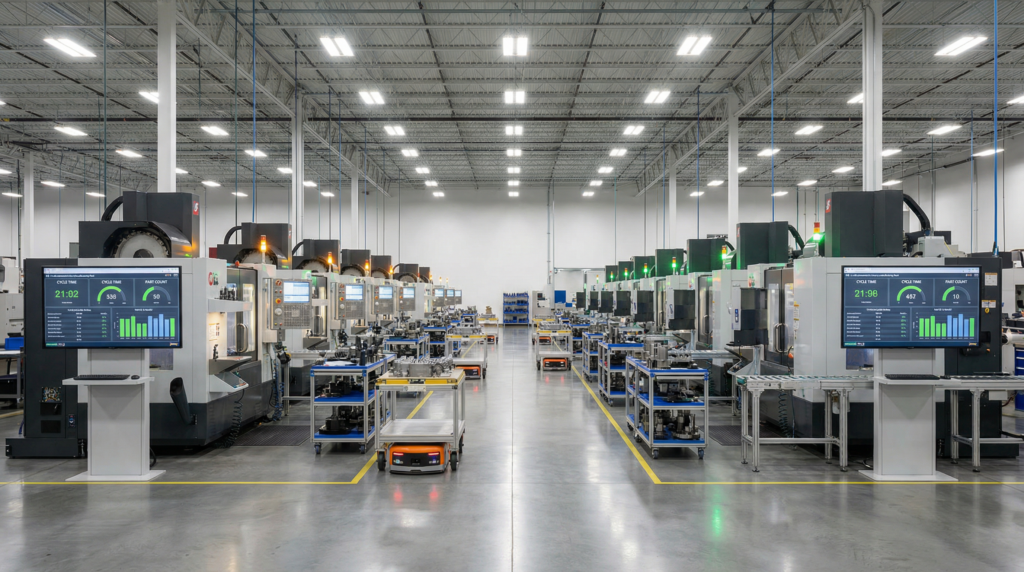
The real power of an enterprise MES is not just that it can be installed in multiple plants, but that it can represent data and workflows in a consistent way across them.
Proficy Plant Applications MES automates and integrates information-related activities for production execution and performance optimization, creating a coherent data foundation for OEE, downtime, throughput, quality, and other critical KPIs.
Examples like the Quality Management capabilities allow sites to define product-specific limits and collect quality data through user friendly displays, but all within a common quality framework.
In practice, this means a pharmaceutical site can set tight, regulatory-driven limits and electronic signatures while a food plant structures checks around HACCP plans, but both use the MES for quality events, specifications, and electronic records.
The MES’s support for regulatory compliance, including rules such as FDA 21 CFR Part 11, helps standardize compliant practices across regulated and non‑regulated plants without developing separate point solutions.
Configurable Interfaces and a Connected Workforce
One of the key reasons Proficy Plant Applications MES works in such diverse environments is its focus on configurable, web-based user experiences and a connected workforce.
Modern releases include out-of-the-box web clients and a no-code or low-code environment for building operational dashboards and apps, so plants can shape the MES experience around how they actually run, instead of the other way around.
These web-first UIs can be easily customized by local teams to provide a single contextual pane of glass for supervisors and operators, putting real time information in front of them anywhere they have browser or mobile access.
This combination of prebuilt screens and low-code tooling matters in heterogeneous plant networks where every site has its own realities and constraints.
A high-speed bottling facility can use standard downtime and OEE views with only minor tweaks, while an aerospace or heavy equipment plant can design more complex, work-instructed flows or nonconformance workflows using the same low-code layer.
Integrators and internal manufacturing IT teams can roll out a common UX pattern, branding, and navigation across plants while tailoring the content to each operation.
Proficy MES’s integration with Proficy Operations Hub reinforces this connected workforce model with centralized, customizable dashboards that span lines, plants, and even regions.
The focus on uptime for the MES itself is equally important in multi-plant deployments.
Current Proficy Plant Applications web clients are designed to be updated with little or no disruption, letting operators continue to interact with MES during many types of updates.
For enterprises with dozens of facilities, this reduces the coordination burden and risk during upgrades, because the MES can be advanced centrally with minimal planned downtime at each site, helping keep the software estate more consistent and current.
Enterprise Scalability, Deployment Flexibility, and Cost Control

For corporate IT and operations technology teams, one of the biggest arguments for a single enterprise MES is total cost of ownership.
Velotic emphasizes that Proficy Plant Applications can help reduce costs, maintenance, and training by serving as a single enterprise-wide MES solution covering process, discrete, and mixed manufacturing.
Instead of managing different vendors, architectures, and skill sets for each plant type, teams invest in one platform, one set of integration patterns, and one user training curriculum.
Proficy Plant Applications MES supports on premises as well as cloud-based deployments, providing architectural flexibility and scalability for different IT strategies.
A manufacturer can deploy the MES centrally in the cloud to serve multiple sites, choose local on-premises instances for plants with strict latency or connectivity requirements, or run hybrid architectures as they transition.
Recent Proficy Plant Applications releases have focused on improving performance and reducing infrastructure footprint, which makes it easier to scale MES across many plants without runaway hardware costs.
Real-world deployments show why this matters at scale: when a large manufacturer saves even a few minutes of execution time per shift, per line, those minutes compound across business units into hours of recovered capacity every day.
Taken together with reductions in inspection effort, lower unplanned downtime, and increased throughput, these gains create a strong case for treating MES as an enterprise standard rather than a series of disconnected site projects.
Why Proficy Plant Applications MES Fits Diverse Plant Types
Tying these elements together, Proficy Plant Applications MES fits diverse plant types because it balances standardization and configurability along multiple dimensions.
It provides a unified module set and data model that applies to process, discrete, and mixed-mode plants, but allows each site to configure assets, products, quality limits, and workflows according to its operational reality.
The common KPIs, quality structures, and genealogy capabilities let leadership compare performance and enforce best practices, while the low-code, web-based UI environment empowers local teams to tailor operator experiences without breaking the enterprise template.
At the same time, the platform’s proven track record in different sectors, from paper and beverage to automotive, pharmaceuticals, and batteries, demonstrates that the MES is not merely “generic” but capable of handling specific industry requirements when configured properly.
For many manufacturers, the choice is not between a “perfect” point solution for each plant and a one size fits all enterprise MES; rather, they get a configurable enterprise MES that has already been battle-tested in each of their key verticals, delivered as a single product family.
FAQ
Q: What is Proficy Plant Applications MES in simple terms?
A: Proficy Plant Applications MES is a manufacturing execution system that manages production, quality, efficiency, and batch operations across process, discrete, and mixed-mode facilities, providing real time visibility and control in one platform.
Q: How does Proficy Plant Applications MES support different types of plants with one system?
A: It uses a common modular architecture and data model that can be configured for different industries, allowing a paper mill, an automotive plant, and a beverage facility to share the same MES while tailoring assets, BOMs, and workflows.
Q: What real-world results have manufacturers achieved with Proficy Plant Applications MES?
A: Documented outcomes include 4 million dollars in annual savings at a paper company, a 40 percent reduction in inspection costs at an automotive manufacturer, and a 39 percent decrease in bottling line downtime events for a beverage producer, along with major throughput and downtime improvements in other sectors.
Q: Why is Proficy Plant Applications MES a good fit for enterprise-wide MES standardization?
A: It offers broad industry coverage, flexible on premises and cloud deployment, modern web and low-code interfaces, and proven ability to reduce costs, maintenance, and training by consolidating diverse plants on a single MES platform.
P.S. Rain Engineering has spent years helping manufacturers implement Proficy Plant Applications MES as a true enterprise platform instead of a set of isolated plant projects.
By combining our implementation experience with Velotic’s proven MES capabilities, we help operations and IT teams standardize on a single solution, accelerate deployments to very different plant types, and turn multi-site data into a competitive advantage across the entire manufacturing network.
Ready to take your MES to the next level?
