




Article Summary
- This article explains how to prepare your MES and Proficy data so future AI initiatives in your plant have a solid chance of working as advertised.
- It focuses on readiness work: data quality, standardization, context, and governance, not on AI features that may or may not be available today.
- It shows how treating MES data as a strategic asset positions your plant for the next wave of AI-enabled smart manufacturing.
- It highlights how Rain Engineering can help design and execute a practical roadmap from today’s MES reality to AI‑ready operations.
Artificial intelligence is becoming a bigger part of manufacturing strategy, but most plants are still in the preparation phase rather than the fully autonomous phase.
Manufacturers are exploring how AI might support maintenance, quality, planning, and process improvement, while discovering that none of those use cases deliver dependable value without reliable plant data underneath.
The conversation is shifting from “Which AI algorithm should we use?” to “Is our MES and Proficy data ready for AI at all?”
This is where the idea of an “AI‑ready MES” becomes useful.
It does not mean your current MES is already full of advanced AI or that your plant is on the verge of lights‑out automation… It means structuring, cleaning, and governing your production data today so that when you do add AI tools tomorrow, they have something trustworthy to work with.
In this article, we will look at what “AI‑ready MES” really means, how industry trends around AI and smart factories inform that definition, and the concrete steps you can take inside your plant to prepare Proficy data so future AI actually works.
Why AI‑Ready MES Is About Preparation, Not Hype
Recent industry discussions around AI in manufacturing emphasize potential rather than widespread maturity.
Many plants are running pilots, proofs of concept, and small‑scale experiments rather than fully rolled out AI across every line and site.
That gap between ambition and reality often comes down to data: AI models are very sensitive to gaps, inconsistencies, and noise in the data they consume.
Traditional MES deployments, including those built around Proficy, were often implemented to meet immediate execution and reporting needs.
They might have grown over time as new lines were added, automation changed, or ERP integrations evolved.
In many plants, that history has left a data footprint that reflects local decisions, naming conventions, and shortcuts.
It still runs the plant, but it is not immediately ready to feed AI.
AI‑ready MES is about acknowledging this gap and treating it as a design and cleanup problem, not a software brochure problem.
Instead of assuming AI is “inside the MES” and ready to go, it frames MES as the central source and organizer of production data that can be shaped to support AI when the time is right.
What AI Needs from Your Plant Data

Even though AI tools differ, they generally share a few core needs from your MES and Proficy environment.
These needs are not futuristic; they are basic data disciplines that many plants are only now starting to formalize.
- First, AI needs consistent, high‑quality records.
When there are multiple names for the same product, duplicated equipment identifiers, or missing values in key fields, models either fail outright or give unreliable results.
What works for a human who knows the plant by heart often confuses an algorithm that only sees strings and numbers.
- Second, AI needs a unified way of describing core manufacturing objects.
Orders, equipment, work centers, materials, and downtime reasons should follow stable structures and vocabularies.
If similar things are represented differently from one line, site, or system to another, AI must untangle that before it can reason about performance, quality, or risk.
That untangling is much easier to do at the MES level than inside each individual AI project.
- Third, AI needs context around time‑series and event data.
Sensors, PLCs, and automation produce a constant stream of readings, states, and timestamps.
For those signals to be useful to AI, they have to be linked to what was running, which product was in process, which order the run belonged to, and what the target conditions were… Raw tags alone are rarely enough.
- Finally, AI needs ongoing governance.
Data quality is not a one‑time cleanup exercise.
Plants change.
Products change.
Automation changes.
Without regular monitoring, validation rules, and clear ownership, the quality of MES data tends to drift over time, pulling AI models down with it.
Using Proficy as a Data Foundation for Future AI
Proficy Smart Factory and similar MES platforms already sit at the intersection of equipment, operators, and business systems.
They collect events from the shop floor, track orders as they move through operations, manage recipes or routings, and provide the basic traceability that many plants rely on.
That central position makes Proficy a natural foundation for future AI work, as long as its data is treated with an eye toward readiness.
The key is to see your Proficy implementation not only as today’s execution engine, but also as tomorrow’s data source for AI tools.
That mindset changes how you approach configuration and integration.
Equipment hierarchies, product structures, and event models are no longer just checkboxes to make reports run; they become ingredients in a data model that AI will eventually consume.
In practice, this often means slowing down long enough to ask:
Are equipment and line hierarchies modeled in a way that reflects how the plant actually thinks about assets and constraints?
Are product and material identifiers consistent across Proficy, ERP, and other systems that will also feed AI?
Are events such as downtime, quality holds, and changeovers captured with reasons and attributes that explain “why,” not just “what” and “when”?
By answering those questions early, the plant avoids scrambling later when an AI initiative needs a stable, clean representation of the manufacturing world.
Cleaning And Standardizing MES Data Before AI Arrives

… It is not glamorous, but it pays off.
There are a few common patterns in how manufacturers approach this work around their MES and Proficy environments.
One pattern is data profiling.
This is the practice of taking a systematic look at key MES tables, time‑series feeds, and integration points to understand where data is missing, out of range, or inconsistent.
Rather than fixing things only when a problem surfaces, the plant deliberately scans its data to see where AI would struggle.
Those findings then inform a cleanup plan.
Another pattern is standardization of master data and semantics.
Plants that have grown through acquisitions, multiple waves of automation, or local configuration changes often have different naming conventions and codification schemes across lines or sites.
Bringing those into a standard, governed structure is a significant step toward AI readiness.
It also tends to make day‑to‑day MES use easier, which is a bonus.
A third pattern is relationship cleanup.
AI is very sensitive to errors in relationships such as “this equipment produced that product on this order using this material.”
When those links are broken or incomplete, models receive a distorted picture of what is really happening.
Checking and reinforcing these relationships within MES and its integrations is a core part of readiness work.
All of this can be done incrementally.
Plants do not need to stop production or redo everything at once.
They can start with a single line, a high‑value product family, or a specific problem area, then expand as they see benefits.
Adding Context to OT Data So AI Can Understand It
A lot of the excitement around AI in manufacturing comes from the sensor and IoT side: vibration analysis, image inspection, energy data, and so on.
Those signals are important, but without context they are hard for AI to interpret.
MES is one of the best places to add that context.
For example, time‑series data from a machine becomes much more useful once it is connected to the work order, product, specification, and target parameters for that run.
That connection allows future AI tools to see how process signals behave when the plant is on target versus when it drifts.
Similarly, contextual information such as equipment capabilities, maintenance history, changeover patterns, and staffing can be associated with events and runs.
When AI eventually analyzes performance, it can tell the difference between a one‑off incident and a pattern tied to a particular combination of product, shift, and configuration.
Even if the plant is not yet deploying advanced models, every step taken to tighten that thread improves the quality of insights that will be possible in the future.
Planning AI Use Cases Around Data Readiness

It is tempting to start AI conversations with model types and tools.
A more grounded approach is to start with the business problems and then ask what data those problems require.
That perspective keeps expectations realistic and makes it easier to see where MES and Proficy need attention.
For instance, a plant that wants to explore predictive maintenance should look closely at how it captures equipment states, alarms, operating conditions, and maintenance history.
A plant interested in quality prediction should examine its product genealogy, inspection records, process parameters, and material attributes.
A plant chasing schedule reliability should focus on order events, changeovers, and resource constraints.
Each of those use cases will rely heavily on MES data, but in different ways.
By mapping them explicitly to specific objects, fields, and relationships within Proficy and related systems, the plant gains a clear, prioritized list of data improvements that will directly support real outcomes.
This is far more productive than assuming “AI will figure it out” on top of a messy data landscape.
Governance, Stewardship, And Human Oversight
No matter how advanced AI becomes, plants will still need people to define rules, review insights, and make decisions.
That is especially true in regulated environments or where safety is at stake.
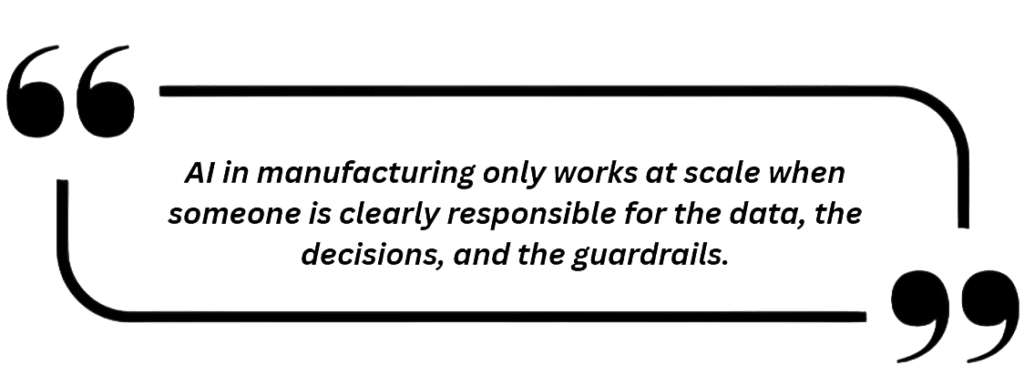
AI‑ready MES therefore includes not just technical data work, but also governance and oversight.
Governance starts with clearly defined ownership for key data domains.
Someone is responsible for equipment hierarchies, someone for materials and products, someone for order structures and calendars, and so on.
Without that, data quality tends to drift and AI initiatives have a moving target.
Stewardship also involves monitoring.
Plants that prepare for AI often implement basic dashboards or checks that show whether critical MES data is complete and within expected ranges.
Over time, these checks can evolve into automated rules and alerts, but even simple visibility makes a big difference.
Finally, human oversight is essential when AI tools begin to interact more directly with MES workflows.
Even in the future, when Proficy and other systems host AI assistants or recommendations, plants will likely want human‑in‑the‑loop review for changes that affect setpoints, schedules, or quality decisions.
Designing that oversight path early makes AI adoption smoother when it arrives.
How Rain Engineering Helps Build An AI‑Ready Foundation

Preparing an MES and Proficy environment for AI requires a mix of manufacturing understanding, data modeling, and system integration.
It is as much about plant reality as it is about technology.
Rain Engineering works at that intersection.
Typical engagements focus on taking what already exists, understanding how the plant actually runs, and then reshaping MES and Proficy configurations so they support both current operations and future AI ambitions.
That might mean redesigning equipment and product models so they reflect constraints more clearly, tightening up integrations so master data stays in sync, or enriching event capture so interruptions have meaningful, analyzable reasons attached.
Because this is a journey, not a one‑time project, Rain Engineering helps plants think in phases: starting with a few lines or use cases, proving the value of cleaner and more contextual data, and then expanding from there.
The intent is not to promise AI that “just works” on day one, but to make sure that when AI tools are brought in, they find a well‑organized digital environment rather than a tangle of ad‑hoc data.
FAQ
Q: What does “AI‑ready MES” actually mean for a plant today?
A: It means treating MES and Proficy data as a long‑term asset, cleaning it up, standardizing it, and adding the context and governance needed so that future AI tools can work with it reliably.
Q: Do we need to wait for specific AI features inside MES before we start?
A: No. Most of the work involved in becoming AI‑ready is about data modeling, integration, and governance, all of which can begin now, regardless of which AI tools will be used later.
Q: How do we know where to focus first?
A: Start from one or two important business problems, then map those use cases to concrete MES data requirements. The gaps between what you need and what you have today will show you where to begin.
Q: What if our MES and Proficy setup is already live and complex?
A: That is normal. AI readiness is usually an evolution of an existing system, done in phases, rather than a full restart. Incremental improvements can deliver value while the plant keeps running.
P.S. Rain Engineering partners with manufacturers who want to make practical progress toward AI‑ready operations, beginning with the MES and Proficy environments they already have. By aligning data models with real plant behavior, tightening integrations, and putting governance around critical information, Rain Engineering helps build the quiet foundation that future AI will depend on. If you are planning your next Proficy project or considering AI pilots and want to avoid rework later, Rain Engineering can work with your team to design an AI‑ready roadmap that fits your plants, not a generic template.
Ready to get started?
