





Article Summary:
- Data silos hide the real story of your plant, forcing teams to make decisions on partial, outdated, or conflicting information instead of a single source of truth.
- When production, quality, maintenance, and supply chain all live in separate systems, you pay for it in extra downtime, rush orders, scrap, and constant firefighting.
- Breaking down silos isn’t a “nice to have”—it’s how you get reliable, real-time visibility, faster decisions, and a foundation ready for MES, AI, and continuous improvement.
Look… if you’re still tracking production in spreadsheets while your MES sits over there doing its own thing, we need to talk.
I’ve walked through hundreds of manufacturing facilities over the years, and honestly? The number of times I’ve seen expensive systems that don’t actually talk to each other would make you laugh… if it wasn’t costing companies millions.
But here’s the thing that really gets me – most manufacturers don’t even realize they’re bleeding money because of data silos. They know something’s wrong (the reports never match, people spend hours hunting down answers), but they think it’s just “how manufacturing works.”
It’s not. And you don’t have to live with it.
What Are Data Silos, Really? (And Why They’re Killing Your Bottom Line)
Data silos are basically what happens when your systems become like teenagers – they don’t communicate with each other, even though they’re living in the same house.
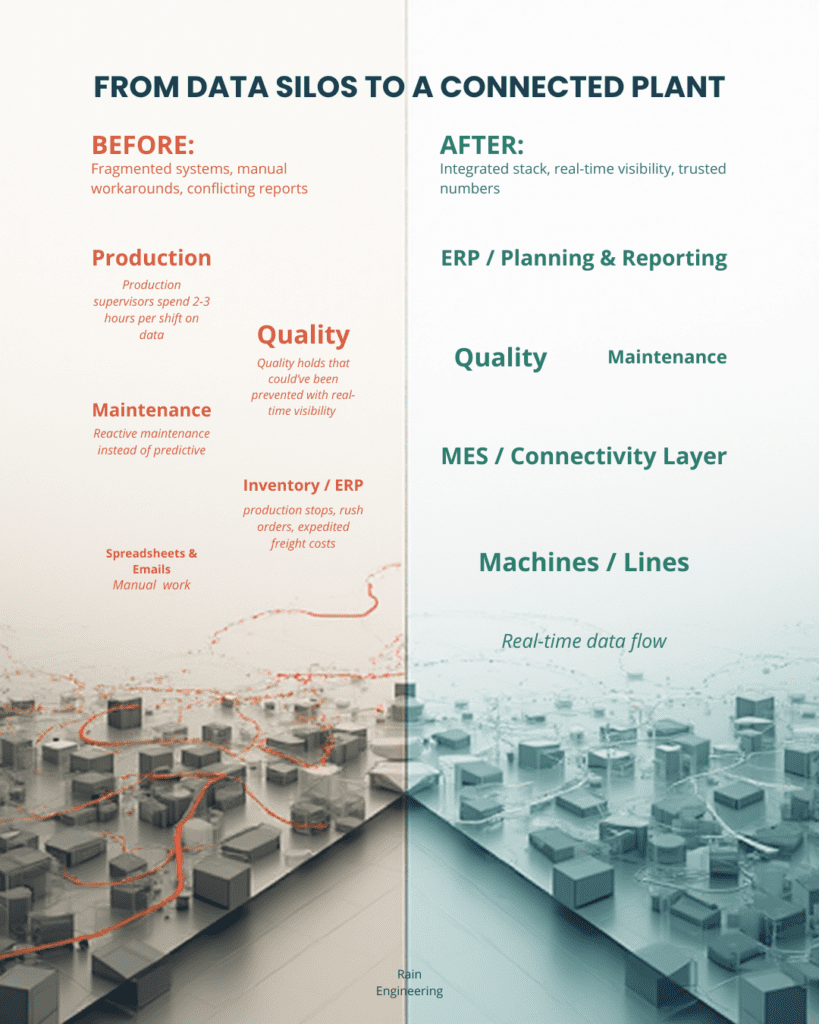
Your MES tracks production. Your ERP handles inventory. Your quality system manages specs. Your CMMS tracks maintenance. And somehow… none of them know what the others are doing.
So when your production manager needs to know if that batch delay was because of materials, maintenance, or quality issues? Good luck. Time to make some phone calls, check three different systems, and hope the information you get is actually current.
That hunting and gathering? It’s expensive. Really expensive.
The Real Numbers (That’ll Make Your CFO Cringe)
Let me share what we typically see when we help manufacturers calculate the true cost of their data silos:
Time Waste:
- Production supervisors spend 2-3 hours per shift just gathering data from different systems
- Plant managers waste 6-8 hours weekly creating reports that should be automatic
- Quality engineers lose 4-5 hours per week tracking down batch information across systems
Decision Delays:
- Production decisions delayed by 30-45 minutes while gathering information
- Root cause analysis takes 3-5x longer when data lives in separate systems
- Equipment issues go unresolved because maintenance history isn’t connected to production data
Mistakes and Rework:
- Incorrect material usage because inventory systems don’t sync with production
- Quality holds that could’ve been prevented with real-time visibility
- Overtime costs because scheduling decisions are based on incomplete data
But the biggest cost? Opportunity cost.
All those smart people you hired to improve operations? They’re spending their time being data detectives instead of solving actual problems.
The Manufacturing Data Silo Calculator: What’s This Really Costing You?
Before we dive deeper, let’s get real about your specific situation. Use our calculator app here or estimate it manually with the following formulas:
Manual Data Collection Costs
- Hours per week spent gathering data manually: _____ hours
- Average hourly cost (including benefits): $_____
- Weekly cost: _____ hours × $_____ = $_____ per week
- Annual cost: _____ per year**
Decision Delay Costs
- Production decisions delayed per day: _____ decisions
- Average delay time: _____ minutes
- Cost per minute of production delay: $_____
- Daily delay cost: _____ decisions × _____ minutes × $_____ = $_____ per day
- Annual delay cost: _____ per year**
Quality and Rework Costs
- Preventable quality issues per month: _____ incidents
- Average cost per quality incident: $_____
- Monthly quality cost: _____ incidents × $_____ = $_____ per month
- Annual quality cost: _____ per year**
Opportunity Cost (Conservative Estimate)
Total measurable annual cost: $_____ + $_____ + _____ per year**
Real opportunity cost (typically 2-3x measurable costs): $_____ per year
Most manufacturers are shocked when they run these numbers. A mid-sized plant typically discovers they’re losing $800K to $2.3M annually to data silos.
The Five Types of Manufacturing Data Silos (And How They’re Hurting You)
Not all data silos are created equal. Let me walk you through the five most common types we see, and how each one creates its own special kind of chaos:
1. The Production-Quality Disconnect
What it looks like: Your MES tracks what you made, your QMS tracks what you tested, but neither system knows what the other is doing.
The pain: When quality finds an issue, production can’t quickly identify which batches are affected. When production has a problem, quality can’t see if it’s part of a pattern.
Real example: A food manufacturer we worked with had a contamination issue. It took them 18 hours to figure out which products were affected because their production and quality systems didn’t talk. In the food industry, 18 hours of uncertainty can mean millions in recalls.
2. The Maintenance-Production Gap
What it looks like: Your CMMS knows when equipment was last serviced, but your production system doesn’t know why Line 3 keeps having micro-stops.
The pain: Reactive maintenance instead of predictive. Equipment failures during critical production runs. Maintenance costs that are 40-60% higher than they should be.
Why it matters: When production data and maintenance history live in separate worlds, you’re basically flying blind on equipment health.
3. The Inventory-Production Mismatch
What it looks like: Your ERP thinks you have plenty of raw materials, but production just stopped because you’re out of a critical component.
The pain: Unexpected production stops, rush orders, expedited freight costs, and really frustrated customers.
The kicker: This usually happens because your ERP updates inventory every few hours, but your production reality changes every few minutes.
4. The Planning-Reality Chasm
What it looks like: Your scheduling system created a beautiful plan based on theoretical capacity, but it has no idea that Machine 2 is running 15% slower than spec because of a bearing issue.
The pain: Missed delivery dates, last-minute schedule changes, and a planning team that’s constantly playing catch-up with reality.
5. The Reporting Nightmare
What it looks like: Every system generates its own reports, but good luck getting them to agree on basic facts like “How much did we produce yesterday?”
The pain: Meetings where half the time is spent arguing about which numbers are correct instead of solving actual problems.
And here’s what really drives me crazy… most manufacturers just accept this as “normal.”
It’s not normal. It’s expensive.
Why Data Silos Happen (It’s Not Your Fault, But It Is Your Problem)
Look, I’m not here to blame anyone. Data silos don’t happen because people are lazy or stupid. They happen because:
The “Best of Breed” Trap
Someone sold you on the idea that you should buy the best system for each function. Best MES, best ERP, best QMS, best CMMS.
Sounds logical, right?
Problem is, “best” usually means “best at doing one thing really well while completely ignoring everything else.”
So you ended up with a collection of really good systems that don’t play nicely together.
The “We’ll Integrate Later” Promise
How many times have you heard this one?
“Don’t worry, we can integrate these systems later. The APIs are well-documented.”
Six months later, you’re still trying to get System A to talk to System B, and your IT team is pulling their hair out.
The Gradual Accumulation Problem
Most data silos don’t appear overnight. They sneak up on you:
- Year 1: You implement an MES. It works great.
- Year 2: You add a new quality system because the old one was terrible.
- Year 3: You upgrade your ERP to get better financials.
- Year 4: You realize nothing talks to anything else.
The “Good Enough” Acceptance
And then there’s the most dangerous trap of all… getting used to it.
“Well, it’s a pain, but Sarah knows how to pull data from all three systems and create the report we need.”
What happens when Sarah leaves? What happens when Sarah’s manual process misses something critical?
Spoiler alert: Nothing good.
The Real Impact: Stories from the Shop Floor
Let me tell you about a few manufacturers we’ve worked with. (Names changed, obviously, but the pain was real.)
Case Study 1: The $400K Inventory “Glitch”
Medium-sized automotive parts manufacturer. Their ERP said they had 30 days of raw steel inventory. Their production planning was based on this number.
Reality? They had about 3 days of usable inventory because their quality system had put holds on material that the ERP didn’t know about.
Result? Emergency orders, expedited freight, production line shutdowns, and very unhappy customers.
Cost: $400K in expedited materials and lost production, plus immeasurable damage to customer relationships.
Time to fix once they integrated the systems: 3 weeks.
Time they lived with the problem before calling us: 2 years.
Case Study 2: The Phantom Quality Issues
Food and beverage manufacturer with a beautiful MES that tracked everything… except quality data.
When they had quality issues, it took an average of 6 hours to identify which production runs were affected. During those 6 hours, potentially affected product kept shipping.
The breakthrough: Once we connected their quality system to their production data, they could identify affected batches in under 10 minutes.
Result: 90% reduction in recall scope, 75% reduction in quality investigation time, and a lot less stress for everyone involved.
Case Study 3: The Maintenance Money Pit
Discrete manufacturer spending $2.8M annually on maintenance… with terrible results.
Their CMMS tracked maintenance history, but their production system had no idea why certain equipment kept failing.
Turns out, most failures happened during specific product changeovers, but nobody could see the pattern because the data lived in separate systems.
After integration: 35% reduction in maintenance costs, 60% reduction in unplanned downtime.
The plant manager’s reaction: “Why didn’t anyone tell me this was possible three years ago?”
The Hidden Costs You’re Not Even Counting
The examples above are the obvious costs – the ones that show up on reports and get people’s attention.
But there are sneakier costs that are probably hurting you right now:
Decision Fatigue and Analysis Paralysis
When getting data is hard, people stop asking questions. They make decisions based on gut feel instead of facts because pulling the real data is too much work.
How many improvement opportunities are you missing because the data to identify them is trapped in silos?
Employee Frustration and Turnover
Your best people didn’t sign up to be data archaeologists. They want to solve problems, improve processes, and make things better.
When they spend half their time hunting for information that should be at their fingertips, they get frustrated. Really frustrated.
And frustrated good people tend to find jobs where they can actually do good work instead of fighting systems all day.
Innovation Stagnation
Data silos don’t just make operations harder – they kill innovation.
That brilliant idea your production engineer has for improving efficiency? It’ll never get tested because proving it works requires data from four different systems that don’t talk to each other.
Customer Trust Erosion
Every time you can’t answer a simple customer question because your systems don’t agree, you lose credibility.
“When will my order ship?” should be an easy question. When your planning system says Tuesday, your production system says Thursday, and your inventory system isn’t sure you have the materials… well, that’s not exactly confidence-inspiring.
The Integration Imperative: Why Now Is the Time to Act
Look, I get it. You’ve been living with these problems for years. Why fix them now?
Because the cost of disconnected systems is going up, and the cost of fixing them is going down.
The Rising Cost of Silos
Manufacturing is getting more complex:
- More product variants
- Tighter quality requirements
- Faster customer response expectations
- More regulatory compliance demands
When you’re managing 50 SKUs, you can probably get by with manual workarounds. When you’re managing 500 SKUs with customer-specific requirements and traceability demands… good luck with that spreadsheet.
The Falling Cost of Integration
Modern systems are designed to integrate. APIs are standardized. Cloud platforms make data sharing easier.
What used to require months of custom coding can now often be done in weeks with standard connectors.
The Competitive Reality
Your competitors are figuring this out.
The manufacturer who can respond to customer requests in minutes instead of hours… they’re going to win.
The company that can identify and fix quality issues before they become recalls… they’re going to win.
The operation that can predict and prevent equipment failures instead of reacting to them… they’re going to win.
You don’t want to be the company that’s still hunting through spreadsheets while your competitors are making data-driven decisions in real time.
What Does “Good” Look Like? A Vision of Connected Operations
Let me paint you a picture of what your operation could look like with properly integrated systems:
Monday Morning, 7 AM
Your plant manager walks in and opens a single dashboard that shows:
- Weekend production summary (actual vs. planned)
- Current inventory status with quality holds highlighted
- Equipment health scores with maintenance recommendations
- Quality trends with early warning indicators
- Today’s production plan adjusted for real-time reality
Time spent gathering this information: 30 seconds.
Time it takes you now: Probably 2-3 hours, if you get it at all.
Tuesday Afternoon, 2:15 PM
A quality issue is detected on Line 3. Within 60 seconds, the system:
- Identifies all affected batches
- Puts automatic holds on suspect inventory
- Alerts the quality team with full traceability data
- Updates production planning to account for the line stoppage
- Calculates the financial impact
Your response time: Minutes instead of hours.
Customer impact: Minimized instead of maximized.
Wednesday Morning, 6:30 AM
Equipment on Line 2 starts showing early warning signs of bearing failure. The system:
- Correlates the vibration data with production history
- Identifies the optimal maintenance window
- Automatically orders the replacement part
- Schedules the maintenance during the next planned downtime
- Updates production planning to maintain delivery commitments
Result: Planned maintenance instead of emergency breakdown.
Cost difference: About 70% less expensive, plus no disrupted production.
Thursday’s Weekly Planning Meeting
Instead of spending 45 minutes arguing about which numbers are right, the team spends 45 minutes:
- Analyzing trends and identifying improvement opportunities
- Planning process improvements based on real data
- Making strategic decisions about capacity and capabilities
- Actually solving problems instead of hunting for information
Meeting productivity: 500% increase (okay, maybe I can’t quantify that exactly, but you get the idea).
Friday’s Month-End Close
Financial close happens in days instead of weeks because:
- Production data automatically flows to financial systems
- Inventory valuations are real-time and accurate
- Variance analysis is automatic with drill-down capability
- Everyone agrees on the numbers because there’s only one source of truth
Accounting team happiness: Significantly higher.
The ROI Reality: What Integration Actually Delivers
Let’s talk numbers. Real numbers.
Based on our experience with 150+ integration projects, here’s what manufacturers typically see:
Immediate Improvements (0-6 months)
- Time savings: 60-80% reduction in manual data collection
- Decision speed: 70-90% faster problem resolution
- Report accuracy: 95%+ elimination of “which number is right?” discussions
- Quality response: 80-95% faster issue identification and containment
Medium-term Benefits (6-18 months)
- Inventory optimization: 15-25% reduction in carrying costs
- Maintenance efficiency: 25-40% reduction in unplanned downtime
- Labor productivity: 10-20% improvement in operational efficiency
- Quality costs: 30-50% reduction in quality-related expenses
Strategic Advantages (12+ months)
- Customer responsiveness: Ability to provide real-time order status
- Innovation capability: Data-driven process improvements
- Competitive advantage: Faster response to market changes
- Scalability: Ability to handle growth without proportional staff increases
Typical ROI Timeline
Investment payback: 8-18 months
Five-year ROI: 300-500%
Annual savings: $800K – $2.3M for mid-sized manufacturers
These aren’t theoretical numbers – they’re based on actual client results.
The Integration Roadmap: From Chaos to Connected
Alright, so you’re convinced that data silos are expensive and integration is worth it. Now what?
Here’s the roadmap we use with every client (and it works because we’ve refined it through 150+ successful projects):
Phase 1: Assessment and Goal Setting (Weeks 1-2)
What we do:
- Map your current systems and data flows
- Identify the most expensive disconnections
- Prioritize integration opportunities by ROI
- Set clear, measurable goals
What you get:
- Complete picture of your current state
- Prioritized list of integration projects
- ROI projections for each opportunity
- Clear success criteria
Key insight: Most manufacturers are surprised by how many systems they actually have. We usually find 15-25 different systems, spreadsheets, and databases in a typical mid-sized plant.
Phase 2: Communication Planning (Weeks 2-3)
What we do:
- Identify all stakeholders affected by integration
- Develop communication strategy for each group
- Address concerns and build buy-in
- Create change management plan
What you get:
- Everyone understands what’s happening and why
- Reduced resistance to change
- Clear roles and responsibilities
- Realistic timeline expectations
Why this matters: Integration projects fail more often due to people issues than technical issues. We make sure everyone’s on board from the start.
Phase 3: Gap Analysis and Use Cases (Weeks 3-4)
What we do:
- Detailed analysis of data requirements
- Document specific integration scenarios
- Identify technical and process gaps
- Develop detailed use cases
What you get:
- Clear requirements for each integration
- Identification of data quality issues
- Process improvements needed for success
- Detailed technical specifications
Phase 4: Roadmapping (Weeks 4-6)
What we do:
- Sequence integration projects for maximum impact
- Identify dependencies and risks
- Create detailed timeline with milestones
- Plan resource requirements
What you get:
- Step-by-step implementation plan
- Risk mitigation strategies
- Resource allocation schedule
- Clear success metrics for each phase
Strategic approach: We always start with the highest-impact, lowest-risk integrations first. Early wins build momentum and justify continued investment.
Phase 5: Technology Evaluation and Architecture (Weeks 6-8)
What we do:
- Evaluate integration platform options
- Design overall data architecture
- Select appropriate tools and methods
- Plan for future scalability
What you get:
- Technology recommendations tailored to your needs
- Integration architecture blueprint
- Vendor-neutral evaluation (we don’t sell software)
- Long-term technology roadmap
Phase 6: Execution and Change Management (Weeks 8+)
What we do:
- Manage integration implementation
- Provide training and support
- Monitor adoption and usage
- Continuous improvement and optimization
What you get:
- Successful system integration
- Trained and confident users
- Measurable results
- Foundation for ongoing improvements
Common Integration Pitfalls (And How to Avoid Them)
I’ve seen a lot of integration projects over the years. Some go smoothly, others… well, let’s just say there are expensive lessons to be learned.
Here are the most common mistakes manufacturers make, and how to avoid them:
Mistake #1: Starting with Technology Instead of Business Goals
What it looks like: “We need to integrate our MES and ERP” without any clear idea of what that means or why it matters.
Why it fails: You end up with technically successful integration that doesn’t solve any actual business problems.
The fix: Always start with business questions. What decisions do you need to make faster? What problems are you trying to solve? What opportunities are you missing?
Mistake #2: Trying to Integrate Everything at Once
What it looks like: “Let’s connect all 20 systems in one big project.”
Why it fails: Complexity explodes, timelines stretch, budgets blow up, and people get overwhelmed.
The fix: Start with the highest-impact integrations. Build success, learn lessons, then tackle the next priority.
Mistake #3: Ignoring Data Quality
What it looks like: “Once we integrate the systems, our data problems will be solved.”
Why it fails: Integration doesn’t fix bad data – it just makes bad data more visible and consistent.
The fix: Address data quality issues before integration. Garbage in, garbage out still applies.
Mistake #4: Underestimating Change Management
What it looks like: “The technology will be great, people will love it.”
Why it fails: People resist change, especially when it affects their daily routines. Even good changes feel threatening.
The fix: Invest heavily in communication, training, and support. Make people feel included and empowered, not replaced.
Mistake #5: Choosing Integration Technology Based on Vendor Relationships
What it looks like: “Our ERP vendor says their integration platform is the best choice.”
Why it fails: Vendor-specific solutions often lock you into limited options and create new silos.
The fix: Choose integration platforms based on your specific needs, not vendor convenience. Stay vendor-neutral whenever possible.
The Rain Engineering Advantage: Why We Do Integration Differently
Look, I’m obviously biased, but here’s why manufacturers choose Rain Engineering for their integration projects:
We Understand Manufacturing Reality
We’re not IT consultants who happen to work with manufacturers. We’re manufacturing people who understand technology.
We know that:
- Uptime matters more than theoretical performance
- Solutions need to work with the people you have, not the people you wish you had
- Perfect is the enemy of good (and good enough to get started is often perfect)
- Changes need to happen around production schedules, not IT convenience
We Focus on Business Results, Not Technical Features
We don’t get excited about APIs and data models (okay, maybe we do a little). We get excited about:
- Reducing the time it takes to resolve quality issues
- Eliminating manual data entry that adds no value
- Giving plant managers real-time visibility into operations
- Making everyone’s job easier and more productive
We Use Proven Methodologies
Our process isn’t theoretical – it’s battle-tested through 150+ successful projects.
We know what works, what doesn’t, and how to navigate the inevitable challenges that come up in every integration project.
We’re Vendor-Neutral
We don’t sell software, so we’re not trying to push any particular solution. Our recommendations are based solely on what’s best for your specific situation.
Sometimes that means expensive enterprise platforms. Sometimes it means simple, elegant tools that do exactly what you need without the overhead.
We Build Internal Capability
Our goal isn’t to create dependency – it’s to make you self-sufficient.
We transfer knowledge, train your team, and make sure you can manage and extend your integrated systems after we’re gone.
We Share Risk and Success
We’re confident enough in our methodology that we’re willing to tie our compensation to your results.
When you succeed, we succeed. When you don’t, we don’t either.
Taking Action: Your Next Steps
Alright, so you’ve read this far, which means you’re serious about solving your data silo problem.
Here’s what I recommend you do next:
Step 1: Calculate Your Real Cost
Use the calculator we provided earlier to get a rough estimate of what data silos are costing you. Be honest – include all the hidden costs like employee frustration and missed opportunities.
Most manufacturers are shocked by the number. Good. Shock is motivating.
Step 2: Identify Your Biggest Pain Point
Of all the data silos in your operation, which one causes the most daily pain?
- Is it the disconnect between production and quality?
- The gap between maintenance and operations?
- The mismatch between planning and reality?
Start there. Success breeds success, and solving the most painful problem first gives you momentum and credibility for future projects.
Step 3: Get Leadership Alignment
Make sure your leadership team understands both the cost of the problem and the value of the solution.
This isn’t just an IT project – it’s a business transformation that requires executive support and adequate resources.
Step 4: Don’t Go It Alone
I’ve seen too many manufacturers try to tackle integration as a side project with existing staff.
It doesn’t work.
Integration requires specific expertise, dedicated focus, and proven methodologies. Partner with someone who’s been there before and can help you avoid the expensive mistakes.
Use Our Free Data Silo Assessment Tool
Before you make any major decisions, get a clear picture of your current situation.
Our Data Silo Assessment Tool will help you:
- Map all your current systems and data flows
- Identify the most expensive disconnections
- Prioritize integration opportunities by impact
- Calculate potential ROI for each project
- Create a business case for integration investment
This isn’t a sales tool – it’s a practical worksheet you can use whether you work with us or not. Our goal is to help you succeed, and success starts with understanding where you are today.
The Bottom Line: Your Data Doesn’t Have to Be Siloed
Here’s what I want you to remember from this conversation:
- Data silos aren’t inevitable. They’re not just “how manufacturing works.” They’re expensive problems with proven solutions.
- The cost is higher than you think. Those spreadsheets, manual processes, and “we’ll figure it out” workarounds are probably costing you hundreds of thousands or millions of dollars annually.
- Integration is more achievable than you think. Modern technology makes integration faster, cheaper, and more reliable than ever before.
- You don’t have to accept the status quo. Other manufacturers are solving these problems every day. You can too.
- The sooner you start, the sooner you benefit. Every month you delay is another month of expensive inefficiency.
Your people deserve better than spending their days hunting for information that should be at their fingertips.
Your customers deserve better than delayed responses because your systems can’t agree on basic facts.
You deserve better than making critical decisions based on incomplete or outdated information.
The question isn’t whether you can afford to integrate your systems. The question is whether you can afford not to.

Rain Engineering helps manufacturers eliminate data silos and integrate their operations for improved efficiency, quality, and profitability. Our proven methodology has delivered successful integration projects for 150+ manufacturers, with typical ROI of 300-500% over five years.
Ready to stop bleeding money to data silos? Download our free assessment tool or schedule a no-pressure consultation to discuss your specific situation.
FAQ
1. What is a data silo in manufacturing?
A data silo is when critical production, quality, maintenance, or supply chain information is locked in one system or department and can’t be easily shared across the plant.
2. How do data silos hurt plant performance?
They create multiple versions of the truth, slow down root-cause analysis, cause scheduling and inventory surprises, and lead to more downtime, scrap, and rework.
3. Are data silos just an IT problem?
No. They start with technology choices, but the impact is operational—operators, engineers, planners, and leaders all feel the pain when they can’t see the same numbers.
4. How can manufacturers start breaking down data silos?
Begin with a data audit, identify your key systems and “shadow spreadsheets,” then prioritize integrations that give you a real-time view of orders, machines, and quality.
5. What role does MES play in fixing data silos?
An MES sits between machines and business systems, normalizing and contextualizing data so teams can trust KPIs, spot trends, and act on issues while they still matter.
*Update: (07/01/2026)
Over the past year, the financial impact of siloed manufacturing data has become even more quantifiable, with multiple industry studies putting hard numbers on the productivity and quality losses that were once treated as “soft” costs.
Recent analyses of plant‑wide integration projects show that organizations consolidating production, quality, maintenance, and energy data into a unified layer routinely see error rates fall by 30–50 percent and realize triple‑digit ROI from integration work alone, before layering any advanced analytics or AI on top.
At the same time, research into unused industrial data suggests that well over half of the information generated at the factory floor never informs real decisions, essentially turning valuable operational context into noise.
Taken together, these findings reinforce the core argument of this article.
Data silos aren’t just an IT nuisance.
They function as a persistent tax on throughput, first‑pass yield, and continuous improvement.
For manufacturers, the practical takeaway is that breaking down data silos is now a prerequisite for credible AI and smart manufacturing initiatives, not a “nice to have” tucked inside a broader digital roadmap.
Industry voices focused on factory analytics have increasingly pointed out that the real barrier to scaling machine learning and prescriptive insights isn’t algorithm sophistication, but the fragmentation and inconsistency of the underlying data sets.
As standards‑based connectivity, modern MES platforms, and cloud‑native integration patterns become more accessible, companies that move early to normalize tags, unify event histories, and centralize their operational context gain a measurable advantage in forecast accuracy, inventory optimization, and OEE improvement.
This is the space Rain Engineering continues to operate in.
Rain Engineering helps plants replace ad‑hoc data exports and spreadsheet stitching with connected, model‑driven systems that give every team, from operators to executives, the same trusted view of what is actually happening on the line.
