


Article Summary:
- OEE(Overall Equipment Effectiveness), powered by Rain’s OEE Calculator and Proficy MES integration services, exposes hidden downtime, slow running, and quality losses so leaders see the true performance gap in hours, units, and dollars.
- With accurate availability, performance, and quality data, improvement plans shift from opinions to targeted actions (changeovers, training, materials, connectivity) that typically deliver 15–20% OEE gains and fast payback.
- Using the calculator to model scenarios lets you build confident, data-backed capital cases—shortening ROI from years to months and ensuring each MES or automation investment is tied directly to measurable OEE and profitability improvements.
Manufacturers are under pressure to do more with less—less capital, less labor, and less tolerance for late shipments or quality escapes. OEE (Overall Equipment Effectiveness) gives you a single, numerical view of how well your equipment is actually performing by combining availability, performance, and quality into one metric you can track and improve. Rain Engineering’s OEE Calculator and Proficy-based MES deployments turn that metric into daily decision-making fuel, not just a quarterly KPI.
Why OEE (and an OEE Calculator) Matters Right Now
OEE is no longer a “nice-to-have” metric; it is the foundation for data-driven operations and ROI tracking. By quantifying how much time you lose to downtime, slow running, and defects, you expose the gap between what your line could produce and what it actually delivers.
The Rain Engineering OEE Calculator breaks that down into practical inputs plant teams already understand:
- Full window time vs. non-operating time (weekends, off-shifts, planned maintenance).
- Restrained time (upstream/downstream constraints) vs. operating downtime (true equipment failures and interruptions).
- Performance downtime from microstops and running slow.
- Quality cycle loss from failed inspections and scrap.
Instead of guessing at “we’re about 80% efficient,” you can compute OEE from the ground up and see where each loss lives in your day. That is what makes now the best time to invest: you have the tools to see the money you’re leaving on the table, in hours and in dollars.
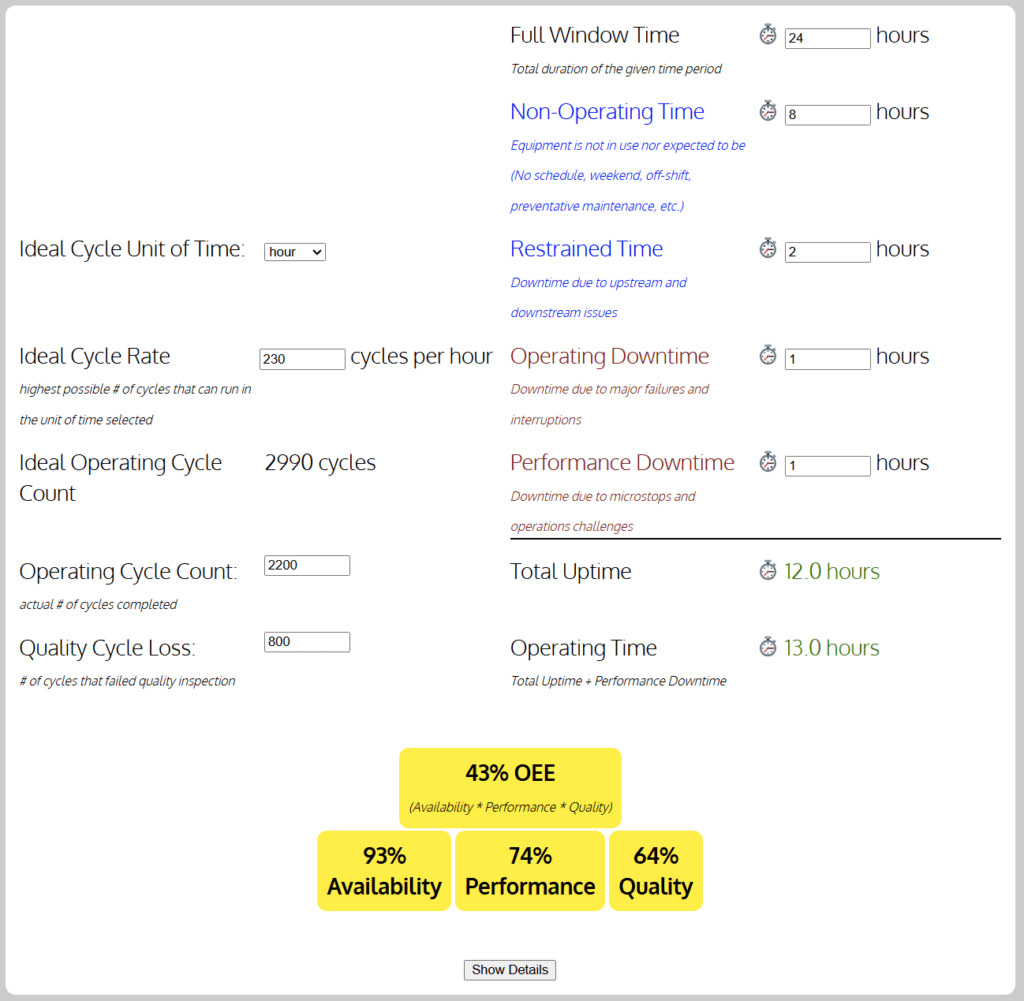
Enter information about your use case and then dive into details using the “Show Details” button.
Reason 1: Real-Time Visibility That Exposes Hidden Losses
Most plants underestimate how much time they lose to small, recurring issues—five minutes here, ten minutes there, plus quality rework that doesn’t show up in simple uptime numbers. The OEE Calculator lets you model these losses in detail, then a connected MES makes that model live and continuous.
Using the calculator, you start with:
- Full window time (for example, 24 hours in a day).
- Subtract non-operating time (say 8 hours of planned downtime), leaving calendar operating time.
- Remove restrained time (such as 2 hours lost waiting on upstream or downstream processes), leaving available operating time.
- Subtract operating downtime from failures and major interruptions to arrive at operating time.
A word of caution: building out a useful system means digging in a getting real.
When Rain Engineering deploys Proficy correctly, clients often discover their actual OEE is 10–15 percentage points lower than they believed. This is because the system captures every stop, microstop, and reject with time-stamped precision. In one automotive example, a plant thought they were at 75% OEE; accurate data showed 65%, and that visibility helped drive a 29% boost to 84% in 12 months.
How to use the OEE Calculator to sharpen the picture:
- Enter a full shift (or week) of data: total hours, planned breaks, and maintenance as non-operating time.
- Classify time lost waiting on upstream/downstream constraints as restrained time, and true machine failures as operating downtime.
- Record actual cycle counts plus scrap to see performance and quality losses numerically.
This tool is built to provide the next iteration in the OEE journey. Enter in your real data and see how it looks.
Even before you invest in a full MES rollout, this exercise will usually reveal a handful of high-impact loss categories you did not fully appreciate.
The tool is designed to get people on the same page and use the same terms. From here, a full MES will start to provide better granularity to the data.
Reason 2: Targeted Improvement Plans Backed by Numbers
Once you have clear visibility into where time and capacity are leaking away, you can design an improvement plan that targets the real constraints instead of the loudest opinions on the floor.
Rain Engineering’s approach combines the OEE Calculator, Proficy MES, and structured implementation services to move from numbers to action:
- Guide Implementation Services help your team implement MES and OEE tracking in phases, beginning with a bottleneck line so you see early results.
- Connectivity services ensure machines, PLCs, and sensors feed reliable data into MES, so OEE numbers are trusted by operators and leaders.
- Manufacturing KnowHow provides role-based training so operators understand not just what the OEE number is, but which behaviors and responses actually move it.
In the automotive client case, accurate OEE and downtime breakdowns shifted the focus of improvement from “we just need a new line” to:
- Attacking long changeovers with SMED practices, cutting changeover time from 45 minutes to 12 minutes (a 73% reduction).
- Reducing scrap by 35% through a clearer view of where and when defects occurred.
- Improving on-time delivery from 78% to 96% by stabilizing throughput and reducing surprises.
The OEE Calculator is a powerful planning tool in that process:
- You can model what happens if you cut operating downtime by 30% or improve quality by 10% and see how OEE and effective capacity change before you spend money.
- You can estimate the impact of a changeover reduction project by adjusting performance downtime and cycle counts, then translate the improvement into extra sellable units per shift.
This turns OEE from a static KPI into a scenario-planning engine you can put in front of operators, engineers, and executives.
Reason 3: Confident, Data-Driven Capital and ROI Decisions
Capital is tight, but competition is not slowing down. The manufacturers who win are those who invest where the data proves a fast payback. OEE—paired with accurate cost and revenue models—gives you that proof.
Rain Engineering has documented cases where Proficy-based MES implementations delivered. When manufacturers pair an MES with OEE and actually change how the plant runs, they typically see:
- 15–20% improvement in OEE as a typical range, not an outlier.
- Payback in 2–6 months versus the 2–3 years often seen with traditional, heavy MES projects.
- Up to 50% or more reduction in changeover times and 25% reduction in planning time through integrated scheduling and standardized procedures.
In the “Hidden ROI” example, a $450K investment in software, services, and training returned:
- $1.8M per year in OEE-driven savings.
- $420K per year from reduced scrap.
- $280K per year from reduced expediting costs.
- Total annual benefit of $2.5M with a 2.2-month payback.
The OEE Calculator helps you build your own version of that business case:
- Start with your actual OEE baseline (calculated from availability, performance, and quality inputs).
- Estimate the uplift (for example, from 60% to 75% OEE) based on achievable reductions in downtime and quality losses.
- Convert that uplift into extra throughput or recovered hours per line per month.
- Multiply by contribution margin to estimate annual benefit, then compare to the cost of MES, connectivity, and support.
Rain Engineering’s integration services and RainCloud MES model are designed to keep that investment focused and incremental, not a “big bang” project that takes years to prove value. Our 24/7 Assurance Support and ongoing optimization, teams continue to increase OEE quarter after quarter instead of stalling after the first wave of improvements.

How to Put the OEE Calculator to Work This Month
If you want a practical starting point before committing to a full OEE and MES initiative, use the OEE Calculator as a structured pilot.
Open the OEE Calculator and follow along use these guidelines to get started.
- Define the window and schedule.
- Separate constrained time from true equipment downtime.
- Quantify performance losses and microstops.
- Measure quality losses.
- Review the OEE breakdown with your team.
- Translate improvements into ROI.
From there, Rain Engineering can help connect your OEE model to real-time data through Proficy integration and a proven implementation path so the numbers are updated automatically instead of manually.
You can choose to have your Proficy MES on-premises or take advantage of the easy RainCloud MES option.
Why 2026 Is Your Window of Opportunity?
The next few years will widen the gap between plants that run on real-time OEE and those that still rely on spreadsheets and “tribal knowledge.”
By combining Rain Engineering’s OEE Calculator, Proficy MES integration expertise, and structured services, you can:
- Establish a trusted OEE baseline and expose hidden downtime and waste.
- Build improvement plans that attack the true constraints, not just visible symptoms.
- Justify investments with clear ROI math and shorten payback from years to months.
If you have even one line that “should be doing more,” start by running a week of data through the OEE Calculator and seeing what your real OEE looks like. Then use those insights as the foundation for a modern OEE and MES strategy that helps your team crush downtime and waste every single day.
FAQ: OEE Investment and the Rain Engineering OEE Calculator
1. How does the OEE Calculator help me decide where to invest first?
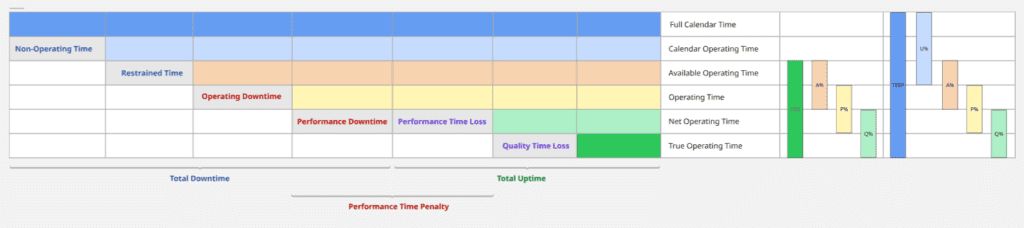
The OEE Calculator breaks your time into clear buckets so you see exactly where capacity is being lost in hours, not just percentages. Buckets include: non-operating, restrained, operating downtime, performance losses, and quality losses. By entering real data from a line or area, you can quickly spot what your first investment should target. Take out the guess work.
2. We already track uptime and scrap. Why do we still need OEE?
OEE can help complete the picture. Uptime and scrap give you partial views. OEE combines availability, performance, and quality into one metric that shows how much of your scheduled time is truly productive.
The Rain OEE Calculator and Proficy-based MES integration highlight microstops, running slow, and hidden defects that uptime and scrap alone miss. This data reveals improvement opportunities that often deliver 15–20% OEE gains and fast ROI.
3. What is a “good” OEE target for most manufacturers?
World-class OEE is often cited around 85%, but most plants find their true starting point is much lower once all downtime, speed losses, and quality issues are accurately captured. The OEE Calculator helps you establish a realistic baseline and then set incremental, line-specific targets—such as a 5–10 percentage point gain over 6–12 months—aligned with your products, processes, and market demands.
