



ARTICLE SUMMARY
- Ongoing MES support keeps food and beverage lines running by preventing small configuration and integration issues from snowballing into costly downtime that erodes throughput and margins.
- Food and beverage manufacturers depend on stable MES platforms to maintain traceability, regulatory compliance, and performance across high speed, high mix operations.
- Industry resources and real-world MES deployments show that continuous optimization and support deliver measurable gains in efficiency, quality, and ROI for food and beverage plants.
- Rain Engineering’s support approach helps manufacturers treat MES as a living system, ensuring long term uptime and value long after the initial go live.
In food and beverage manufacturing, uptime is more than a number on a performance dashboard… It is the heartbeat of the business, influencing everything from order fulfillment and retailer relationships to brand reputation and profitability.
High speed lines, perishable ingredients, and strict regulatory oversight leave almost no room for error or delay.
Manufacturers have increasingly turned to Manufacturing Execution Systems to orchestrate production, but the companies that really pull ahead do something different.
They do not stop at implementation… They treat ongoing MES support as a strategic capability, using it to keep systems healthy, operations agile, and uptime consistently high.
In the following article, we will look at why ongoing MES support has become a secret weapon for food and beverage uptime, how it underpins compliance and traceability, and why partnering with the right MES support team can be the difference between an MES that simply “runs” and one that drives competitive performance.
The High Cost of Downtime in Food and Beverage

Downtime in food and beverage manufacturing is uniquely expensive.
Unplanned stops do not just reduce output… They can increase scrap rates, cause product quality issues, threaten on-time delivery, and complicate compliance with food safety rules.
Industry overviews of MES and manufacturing performance consistently call out unplanned downtime as a major cost driver, especially in sectors where asset utilization and continuous processing are critical, such as food and beverage packaging and processing.
Food and beverage lines often run at high speeds and high volume, particularly in bottling, canning, and packaging.
These operations are tightly synchronized, and even a brief interruption can ripple through upstream and downstream processes.
… Because when MES performance deteriorates, the plant feels it quickly.
MES providers focused on the sector emphasize that MES should boost quality, improve traceability, and increase compliance while helping manage operations in real time, underscoring that downtime and inconsistency are top concerns for their customers.
Operators may not see the latest orders, quality holds may not propagate correctly, and integration messages may queue up instead of posting in real time.
If these issues are not quickly addressed through ongoing support, a plant that invested heavily in MES can still suffer from chronic downtime, frequent workarounds, and a loss of operator trust in the system.
In an industry where production slots at co‑packers and shelf space with retailers are planned tightly, that erosion of reliability has real business consequences.
Ongoing MES support is what keeps the system tuned to plant realities so that uptime remains a strength instead of a vulnerability.
MES As a Living System

One of the most common pitfalls in MES initiatives is treating the project as “finished” at go live.
In reality, MES is a living system.
It must be adjusted as new products are introduced, packaging formats change, equipment is added or replaced, and regulatory requirements evolve.
Industry articles that explain why manufacturers need MES in food and beverage emphasize long term viability, cost management, and compliance, not just a one time modernization project.
For example, this overview of why you need an MES for food and beverage production calls out improved cost management, enhanced compliance, and long term competitiveness as core drivers.
All of that flexibility depends on the MES being kept current and correctly configured.
New SKUs mean new master data, recipes, routings, labels, and quality checks that must be reflected in the system.
New regulatory expectations may require additional checks, tighter traceability, or different labeling logic.
Without ongoing support, these changes are often handled in a fragmented way.
One site might add a quick workaround, another might implement an inconsistent approach, and over time the system can become harder to manage and more prone to errors.
Ongoing MES support, especially from a team that understands both the platform and food and beverage operations, keeps the system aligned with reality.
Instead of building technical debt, the plant gains a mechanism for controlled change.
The same support function that handles incidents can also manage structured configuration updates, test changes in non‑production environments, and ensure that new logic behaves correctly before it reaches the line.
In this model, MES is treated like a core production asset that needs preventive care and tuning, not like a fixed IT deliverable.
Preventing Small Issues from Becoming Big Problems

In many plants, MES issues begin as small inconveniences.
A particular screen is slow to load.
A data field sometimes populates incorrectly.
A report that operators used to rely on no longer matches what they see on the floor.
None of these symptoms may stop production outright at first, but in high throughput food and beverage environments they can quickly compound.
Industry guidance on how MES solutions benefit food manufacturing highlights that MES improves productivity by tracing and analyzing each stage of production to support data driven decision making.
That benefit depends on the data being timely and trustworthy.
Other resources that explore how to optimize maintenance with MES software show how MES helps move plants from reactive maintenance to proactive interventions, but only if events and performance data are captured reliably and the system is actively monitored.
Without ongoing support, system configurations that once worked well can drift.
New logic may be added without fully understanding upstream and downstream impacts.
Integrations with ERP, warehouse systems, and automation controllers may start failing at the edges as volumes or product mixes change.
Operators may respond by building manual spreadsheets or bypassing the system altogether when pressure is high, which erodes the very visibility and control the MES was intended to provide.
Ongoing MES support changes that trajectory.
A support team that continuously monitors system logs, performance metrics, and error trends can catch issues before they become production incidents.
Regular, structured reviews of MES incidents and enhancement requests give operations, quality, and IT a shared forum to address root causes.
Implementation guidance and best practice content on MES implementation strategies for cost savings and improved reporting consistently recommend this kind of structured, ongoing feedback loop with scheduled system reviews, KPI monitoring, and refresher training.
In practice, this means that a slow screen can be optimized before it leads to mis‑keyed entries, a frequently failing interface can be stabilized before it starves downstream systems of critical data, and a confusing workflow can be redesigned before it drives operators back to paper.
Small issues stay small, and the plant avoids a pile‑up of chronic problems that eventually threaten uptime.
Support As a Driver of Continuous Improvement

Beyond maintaining stability, ongoing MES support can become one of the most powerful engines of continuous improvement in a food and beverage plant.
MES sits at the convergence of production data, quality results, and order fulfillment, which means it captures the context needed to understand why the line runs as it does.
When that data is actively used, it can drive meaningful gains in performance.
Discussions of MES and ROI in food manufacturing show how integrating MES with upstream systems enables improved yields, better traceability, and higher profitability.
Other resources that describe how MES solutions enhance efficiency and quality for food and beverage manufacturers explain how MES supports better compliance and quality outcomes by enforcing procedures and providing real time visibility into deviations, hold states, and key process parameters.
A support team that sees all the tickets, enhancement requests, and recurring issues is in a unique position to help operations interpret that data.
Instead of only fixing problems, a mature MES support function will help plant teams look for patterns in downtime reasons, changeover loss, and rework events captured in the system.
From there, the support team can suggest changes to workflows, screens, or data capture strategies that make it easier for operators to do the right thing and easier for supervisors to spot trends.
Best practice content on how to implement and sustain an MES regularly calls out ongoing user engagement, regular system reviews, and continuous optimization as essential steps.
When support is set up as a standing partnership between the plant and MES specialists, MES becomes a vehicle for continuous improvement, not just a repository of what went wrong yesterday.
Ensuring Compliance and Traceability
Compliance is non-negotiable in food and beverage manufacturing.
Regulations around food safety, labeling, allergen control, and traceability have grown more stringent and more data intensive over time.
Across multiple vendors and consultants, MES is consistently positioned as a core enabler for those requirements in food and beverage, because it can enforce process controls, capture detailed records, and support rapid response during audits or recalls.
Overviews that explain what a Manufacturing Execution System is for food producers point to improved food safety compliance, better visibility, and full product genealogy as key benefits.
Likewise, articles on MES solutions that help meet modern food safety regulations describe how MES can support preventive controls, electronic records, and end to end traceability.
Integration focused guides for MES in food and beverage also highlight how connecting MES with ERP and other systems strengthens traceability and compliance by ensuring that data is consistent across the enterprise.
Maintaining that level of control and visibility, however, is not automatic.
It requires that the MES be correctly configured and regularly updated as regulations, products, and suppliers change.
New ingredients, new co‑packers, or new packaging formats all introduce new traceability and labeling requirements.
If the MES is not updated and validated accordingly, records can become incomplete or misleading.
Ongoing MES support provides the structure needed to keep compliance features aligned.
Support teams can help define and maintain electronic batch records, ensure that quality holds and release steps are correctly represented, and validate that new workflows meet both corporate and regulatory expectations.
They can also support mock recalls and periodic audits by helping teams pull targeted traceability reports quickly and consistently.
For food and beverage manufacturers that need to demonstrate due diligence to regulators and customers, that confidence in MES powered traceability is a critical part of uptime.
It is not enough to run the line.
The plant has to prove that it ran correctly.
Maximizing ROI From MES Investments
MES is a major investment in both technology and organizational change.
When implemented and supported well, it has been shown to improve operational efficiency, reduce waste, and increase visibility across the value chain.
Industry discussions of MES implementation strategies for cost savings and improved reporting frequently emphasize that the biggest returns appear over time, as the system is refined and adoption deepens.
Organizations that treat MES as a one-time capital project often see returns flatten or deteriorate after the first wave of gains.
Reports stop evolving with the business.
New lines and products are added in a hurry without robust configuration and testing.
Users develop local workarounds.
Over time, system performance can degrade and leadership begins to question whether the original business case is still being met.
In contrast, manufacturers that commit to ongoing MES support and continuous optimization keep the system aligned with the current reality of the business.
They use support not only to fix issues, but also to revisit dashboards and KPIs, adopt new platform capabilities, and refine data capture so that analytics become more actionable.
For food and beverage manufacturers competing in tight margin markets, that difference matters.
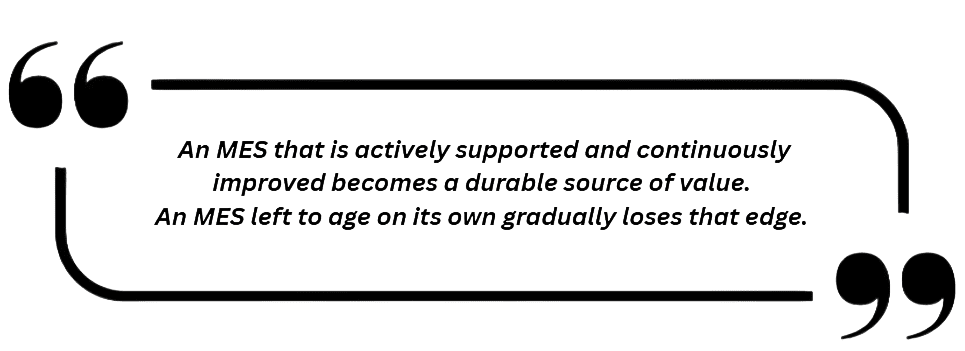
An MES that is actively supported and continuously improved becomes a durable source of value.
It underpins better uptime, faster changeovers, fewer compliance surprises, and more confident planning.
An MES left to age on its own gradually loses that edge.
Building a Resilient and Future Ready Operation

The food and beverage industry continues to evolve rapidly.
Consumer expectations around freshness, sustainability, transparency, and customization are rising.
Product life cycles are shortening.
Retailers and food service providers are tightening delivery windows and traceability demands.
At the same time, digital technologies such as industrial IoT, advanced analytics, and AI are moving from buzzwords to practical tools.
MES sits at the center of how plants respond to these trends.
It is often the system that aggregates shop floor data, enforces process discipline, and connects operational reality to enterprise planning.
When MES is well supported, manufacturers can integrate new sensors and data sources, expose information to new analytics tools, and adapt workflows to new requirements without undermining uptime.
Ongoing MES support is what keeps that central nervous system healthy as the environment changes.
Support teams can help integrate new capabilities, ensure that new products and packaging flows are correctly modeled, and bring best practices from one plant or line to others.
They can ensure that as the plant experiments with new automation, new packaging technologies, or new business models, the MES does not become a bottleneck but instead becomes the foundation.
For manufacturers, that resilience shows up in the ability to add a new product family without disrupting existing lines, to move production between facilities when needed, and to respond quickly when customers or regulators introduce new requirements.
In every case, a well-supported MES helps keep uptime high while enabling change rather than resisting it.
The Wrap Up
In the demanding world of food and beverage manufacturing, uptime is non-negotiable.
MES has become the digital backbone of modern plants, coordinating orders, recipes, quality checks, and traceability.
Yet the real differentiator is not simply having an MES in place.
It is how that system is supported over time.
Ongoing MES support keeps configurations aligned with reality, prevents small issues from turning into major disruptions, and turns the system into a continuous improvement engine rather than a static repository of past events.
For food and beverage manufacturers, that means higher uptime, more reliable compliance, better use of data, and a more resilient operation overall.
With the right support approach and partners, MES becomes a strategic asset that keeps paying dividends well after go live.
FAQ
Q: Why is ongoing MES support important for food and beverage manufacturers?
A: It keeps the MES aligned with changing products, regulations, and processes, preventing configuration drift and reducing the risk of downtime or compliance issues.
Q: How does MES support improve uptime?
A: Support teams proactively monitor performance, address integration and configuration issues early, and continuously tune the system so small problems do not grow into line stopping events.
Q: Can MES support help with regulatory compliance and traceability?
A: Yes. Ongoing support ensures that traceability logic, batch records, and quality flows stay current with regulations and that the system can produce reliable data during audits and recalls.
Q: Does ongoing MES support really impact ROI?
A: It does. Continuous optimization, better user adoption, and fewer disruptions help manufacturers realize the full value of their MES investment over many years instead of just in the first phase.
P.S. Rain Engineering is heading to Automate 2026 (June 22nd– 25th) in Chicago with Velotic, running a live Proficy line at Booth 2853 built around one question: Are you THIS good?
Will you be at Automate 2026?
If so, make sure to set some time aside to stop by Booth 2853 to meet the Rain Engineering team and see why we’re so excited about what we have to show you!
